


A Short History of Chalkboards: From 1801 Slates to Modern Boards
From Scottish schoolrooms in 1801 to modern café menu boards — the 200-year arc of the chalkboard, its classroom decline, and the liquid-chalk-marker revival.
What is a chalkboard?
A chalkboard is a hard, flat, reusable writing surface — originally made of natural slate — designed to hold marks made with chalk or, today, with liquid chalk markers.
The term covers a wide range of surfaces: the traditional classroom slate panel, wall-painted chalkboard coatings, restaurant framed boards, and modern glass/melamine non-porous versions. What they share is the ability to be written on repeatedly and wiped clean.
Who invented the chalkboard?
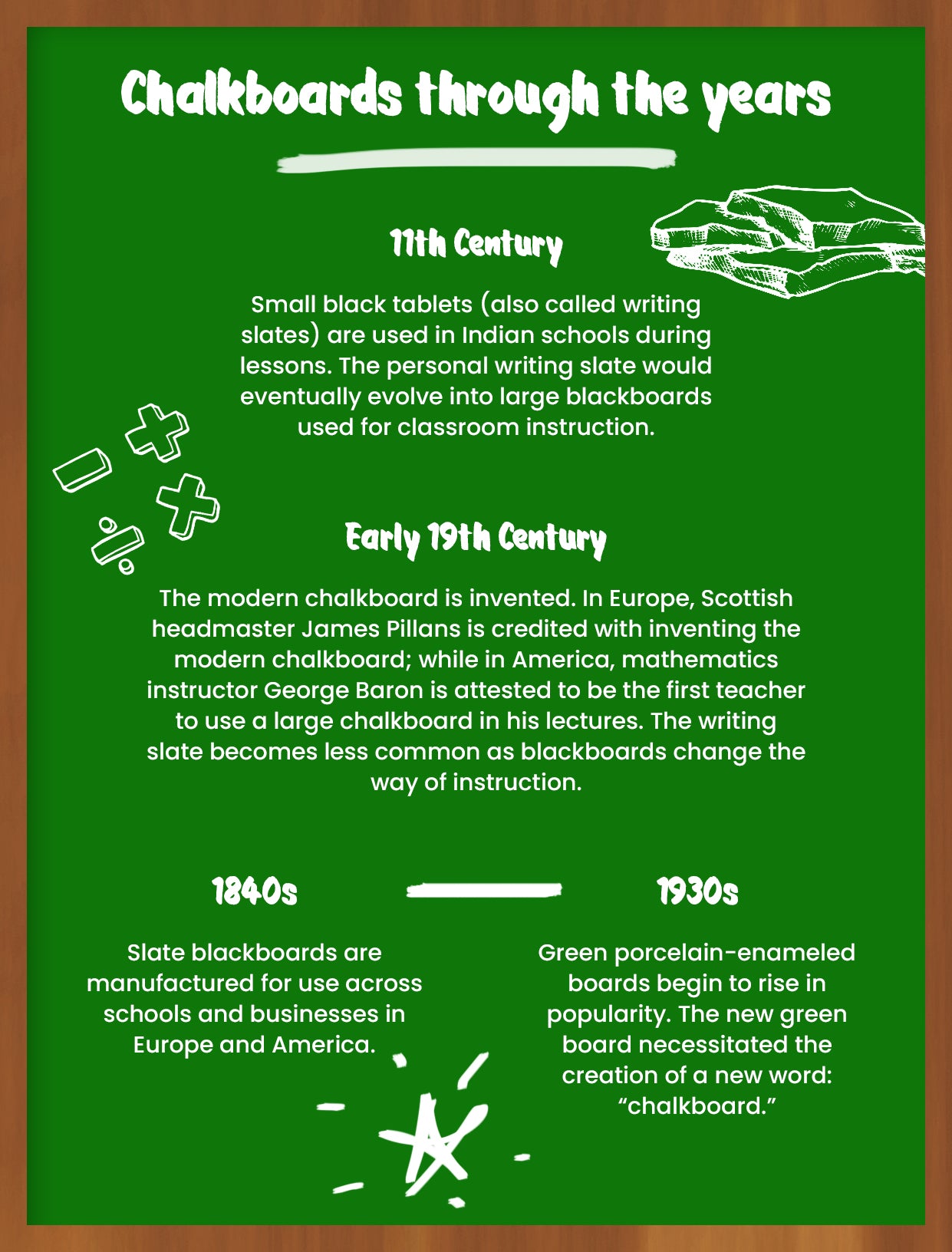
The chalkboard was invented around 1801 when Scottish geography teacher James Pillans hung a large slate on the classroom wall so the whole class could see his map diagrams at once. Before that, students each had individual small slate tablets.
Pillans also invented colored chalk (using a mix of chalk powder and dyes) to highlight different parts of his maps. In the same year, the U.S. educator George Baron independently introduced the wall-mounted chalkboard at West Point Military Academy. Both are credited as inventors depending on which side of the Atlantic you read about it from.
How chalkboards spread through classrooms (1820s–1900s)
By the 1840s, wall-mounted chalkboards were standard equipment in most American schools. By 1900, they were universal across classrooms in the US, UK, and most of Europe.
The material evolved over the century:
- Early 1800s: Natural slate (quarried stone) — heavy, durable, classic black-gray color
- Mid-1800s: Wood boards painted with porcelain enamel — lighter, cheaper to make
- Early 1900s: Painted masonite — mass-produced, schools could afford larger boards
Why chalkboards went green in the 1960s
Classic "black" chalkboards were mostly replaced by green ones during the 1960s. The switch was driven by three factors:
- Glare reduction — classroom fluorescent lights bounced harshly off black surfaces into students' eyes
- Reduced eye strain — green is more restful to read against over long lessons
- Chalk dust visibility — fine white chalk dust shows less on green than on black
"Chalkboard green" (a specific desaturated hunter-green pigment) was nearly universal in American schools by 1970. Schools in the UK and parts of Europe kept black boards longer, partly for tradition and partly because their classrooms had smaller windows and different lighting.
Why are chalkboards no longer used in most classrooms?
Chalkboards were largely replaced in American classrooms between 1980 and 2010 by whiteboards and then smart boards, for three practical reasons.
In the 1980s, whiteboards (also called dry-erase boards) started taking over. Three reasons drove the switch:
- No chalk dust — chalk dust is a known lung irritant for students and teachers with asthma. The American Lung Association and several school districts recommended dust-free alternatives.
- Brighter, more vibrant colors — dry-erase markers produce more saturated marks than chalk, which helped visibility in the back of the classroom.
- Easier cleanup — dry-erase wipes off cleanly with a felt eraser; chalk always leaves some residual "ghosting" that requires a wet cloth.
By 2000, most American corporate offices had gone fully whiteboard. Classrooms followed — by 2010, most newly built schools had no chalkboards at all. They were replaced first by whiteboards, then by smart boards (interactive displays), and in the 2020s by large touch-screen panels.
The modern chalkboard revival (2010s–now)
Chalkboards found an unexpected second life outside the classroom. The invention of liquid chalk markers — water-based pigment in a marker shape — made chalk-style writing possible on non-porous surfaces like glass, melamine, and acrylic-coated boards. This opened up new uses:
- Restaurants discovered that hand-lettered chalk menus look more authentic than printed signs, and can be rewritten daily at no cost
- Cafés and bakeries adopted them as daily-specials signage
- Wedding planners used large framed chalkboards for ceremony signage and seating charts
- Home kitchens installed chalkboard backsplashes and countertop boards for meal planning
- Boutiques used hand-lettered boards for featured product displays
Today the chalkboard market is bigger and more varied than it's ever been — just not in classrooms. You'll find them in cafés, home kitchens, event spaces, boutiques, and back in some specialty art rooms as nostalgic surfaces. The modern chalkboard market is largely non-porous, built for liquid chalk markers rather than stick chalk.
Frequently asked questions
Who invented the chalkboard?
Scottish geography teacher James Pillans in 1801 is the most commonly cited inventor. American educator George Baron introduced a similar wall-mounted slate at West Point the same year, so both are credited depending on which country's history you read. Pillans also invented colored chalk.
Why did chalkboards go green in the 1960s?
Classroom fluorescent lights bounced harshly off black chalkboard surfaces into students' eyes, causing glare and eye strain. Green was more restful to read against, and chalk dust was less visible against green. Most American schools completed the switch by 1970.
Are real chalkboards still used in schools today?
Rarely in U.S. schools built after 2010. Most American classrooms use whiteboards, smart boards, or large touch-screen displays. Chalkboards still exist in some traditional schools, specialty art rooms, and in many countries outside the U.S. where the transition has been slower.
Why did chalkboards come back recently?
Liquid chalk markers, invented in the late 20th century, made non-porous chalkboards practical for restaurants, cafés, weddings, and home use. Hand-lettered chalk signage is now an established style in cafés, boutiques, and event design. The chalkboard never died — it just moved.
What is chalkboard paint?
A thick matte paint containing fine chalk or silica particles that creates a porous writable surface once dry. Popular for DIY kitchen chalkboards, kids' bedrooms, and home accent walls. Apply 2–3 coats over primed drywall or wood, and let cure 3 days before writing.
Why is chalk no longer used in most schools?
Chalk dust is a known respiratory irritant and causes issues for students and teachers with asthma. Dry-erase markers produce brighter colors with no dust, clean up more easily, and interact better with the overhead projectors and smart boards that replaced traditional teaching tools in American schools after 2000.
Tools for your next project
Chalkola favorites — ready to ship.


