


What Are Dot Markers? The Complete Guide
A simple, complete introduction to dot markers (also called bingo daubers) — the art supply that turns toddlers into artists and preschoolers into letter-learners.
1:22 · Chalkola channel · 521 views
Dot markers, in one sentence
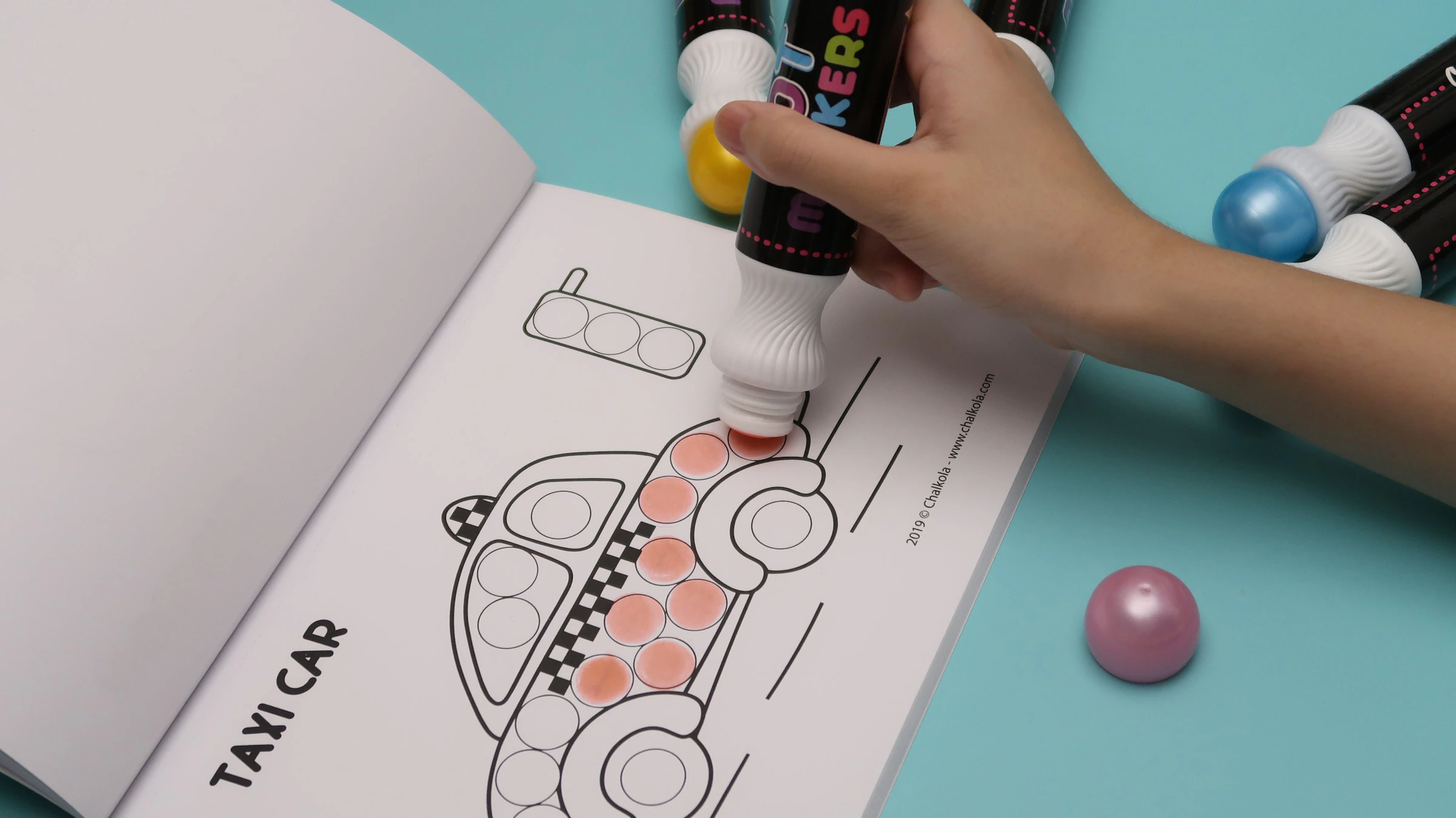
A dot marker is a pen-shaped bottle with a sponge or foam tip that leaves a large, round dot of colored ink when pressed to paper.
The tip is wide — usually 15 mm to 25 mm across — which means no grip pressure, no coloring-inside-the-lines, and no tricky brushwork. Kids and toddlers hold them like a bottle, press down, and a perfect dot appears. That's the whole product, and that's why they work so well for little hands: one press = one dot = one win.
You might also see dot markers called bingo daubers, bingo markers, or dot-a-dot markers. These are all the same product — different names for different audiences. More on that below.
No grip strength needed — but builds it
Toddlers press with an open palm and get a clean dot. Pressing the nib develops hand strength that leads to pencil grip later.
Always inside the lines
Dot placement builds hand–eye coordination without the frustration of coloring books.
Washable formula
Kids' dot markers use water-based pigment ink that washes off skin and most fabrics.
Dot markers vs. bingo daubers: is there a difference?
No — dot markers and bingo daubers are the same product. Just different names for different audiences.
Here's the short history. The foam-tipped ink bottle was first made for bingo halls in the mid-20th century, where players needed a fast way to mark numbers on paper bingo cards without tearing them with a pen. Those were called "bingo daubers" or "bingo markers." They came in basic primary colors, often with permanent ink.
Decades later, parents and preschool teachers noticed how forgiving and fun these bottles were for young children. Manufacturers created a kids' version with washable non-toxic ink, brighter colors, and chunkier bodies. To fit the children's craft aisle, the product was rebranded as "dot markers," "dot-a-dot markers," or "do-a-dot art markers." The core bottle mechanism stayed the same.
| Dot markers (kids' craft version) | Bingo daubers (original) | |
|---|---|---|
| Same bottle & foam tip? | Yes | Yes |
| Target audience | Kids ages 18 mo+, teachers, parents | Bingo players, adult crafters |
| Ink type | Washable, non-toxic, water-based | Often permanent, may not be washable |
| Color range | Bright, full rainbow, shimmer/neon options | Traditional: red, blue, green, purple |
| Sold in | Craft stores, kids' toy aisles | Bingo supply stores, gaming aisles |
| Paper to use | Drawing paper, cardstock, printables | Paper bingo cards |
Traditional bingo daubers often use permanent alcohol-based ink — fine for bingo cards, not safe for children's skin or washable for clothing. For kids, always buy a set labeled "washable" and "non-toxic" (like Chalkola's dot markers).
Bottom line: if you grew up with bingo daubers at grandma's house, you already know how to use a dot marker. It's the same press-and-lift motion. The difference is just which aisle you find them in.
The mechanics of the dot
Inside a dot marker is a reservoir of water-based pigment ink. The tip is a compressed foam or felt disc that acts like a controlled sponge — it releases a measured amount of ink with each press. Shake the bottle once or twice before the first use; when you press the tip to paper, capillary action pulls the ink out evenly and leaves a bold, round mark.
Three variables decide what your dot looks like:
- Pressure — a light press leaves a lighter, more textured dot. A firm press gives you a fully saturated circle.
- Dwell time — holding the tip down longer lets the paper soak up more ink, producing a slightly bigger, bolder dot.
- Paper — absorbent paper (drawing paper, cardstock) drinks the ink and gives crisp dots. Glossy paper can smear until dry.
Most kids will simply press-and-lift, and that's fine. Older kids and art teachers sometimes drag the tip to make short lines or rub two colors together while wet for a simple blend.
Who dot markers are for
Dot markers are a three-generation tool. The same product makes sense for:
Toddlers (18 mo+)
First art experience — too young to hold crayons, but can grip a bottle and press. Starts building fine motor skills.
Preschool & early-elementary kids
Letter recognition, number sense, counting, patterns — dot markers turn worksheets into a game.
Teachers & homeschool parents
Printable do-a-dot pages and reusable activity books make dot markers a staple of preschool curricula.
They're also used by senior centers and memory-care facilities for dexterity exercises, and of course still by bingo players.
How dot markers compare to other kid art supplies
| Dot markers | Crayons | Washable markers | Watercolors | |
|---|---|---|---|---|
| Age suitable | 18 mo+ | 2 yr+ | 3 yr+ | 4 yr+ |
| Grip required | None | Fist/tripod | Tripod | Tripod + brush control |
| Mess level | Low | Very low | Low | High |
| Washable | Yes | Usually | Yes | Yes |
| Color saturation | High | Medium | High | Variable |
| Best for | Counting, letters, patterns | Free drawing | Line art | Painting |
Dot markers fill a gap that other supplies can't: they give a toddler a sense of agency and control — a big, visible mark appears from almost no effort — while also being an effective learning tool for school-age kids who benefit from the structure of fill-the-dot worksheets.
Projects you can do with dot markers
Six directions to go once you have a set at home:
Alphabet & number books
Print free do-a-dot alphabet sheets online. Kids fill each letter shape with dots, learning letter recognition along the way.
Pointillism art
Seurat-inspired dot paintings — landscapes, faces, flowers — all built from single dots of color.
Bug and animal anatomy
Ladybug spots, leopard prints, giraffe patches, fish scales — anything where nature did the work.
Color mixing experiments
Overlap two wet dots to see how red + yellow = orange, blue + yellow = green.
Sticker-chart replacement
Reward charts where kids add a dot for each finished task — cheaper and more fun than stickers.
DIY cards and wrapping paper
Cover kraft paper in rainbow dots for handmade gift wrap, or decorate card stock for birthday cards.
More creative uses are in our Dot Marker Creative Uses guide, and learning-focused ideas in Fun Ways to Learn With Dot Markers.
What can I use instead of dot markers?
If you don't have dot markers, the closest alternatives are do-a-dot stickers, bingo daubers, round paint sponges dipped in paint, or large-tip washable markers used for filling.
Each has tradeoffs. Here's how they compare:
| Alternative | Age range | Pros | Cons |
|---|---|---|---|
| Round stickers / dot labels | 2 yr+ | No mess at all, fine-motor practice (peeling) | Not reusable, less free-flowing creativity |
| Bingo daubers (adult) | 5 yr+ | Same mechanism as dot markers | Often permanent ink — not washable. Check the label. |
| Round sponges + washable paint | 3 yr+ | Any color, any size, fully customizable | Much messier, needs a palette and supervision |
| Fat-tip washable markers | 3 yr+ | Already in most craft drawers | Kids must draw the dot shape, not just press — no "one-press win" |
| Q-tips + washable paint | 3 yr+ | Near-zero cost, tiny dots possible | Each dot is tiny, slow to fill a page |
| Finger-painting | 18 mo+ | Sensory experience, no tools needed | Very messy, no "inside the lines" |
For toddlers under 3, dot markers are genuinely hard to replace — nothing else gives a satisfying big mark with zero grip effort. For older kids, any of the alternatives work for the occasional substitute.
Are dot markers better than crayons for toddlers?
For kids under 3, dot markers are generally better than crayons. For kids 3 and up, both belong in the art drawer — they teach different skills.
Why dot markers win for toddlers (18 mo – 3 yr):
- No grip strength required — but helps build it. Toddlers hold a dot marker like a bottle; crayons need a pincer or tripod grip that doesn't fully develop until age 3. The press-action itself exercises small hand muscles and is the exact motion occupational therapists use as pre-writing practice.
- Bigger visible mark. A dot marker leaves a 20 mm circle; a crayon needs sustained pressure to show. Toddlers feel more successful with dot markers.
- Unbreakable. Crayons snap under toddler pressure; dot markers don't.
Why crayons win once kids are 3+:
- Line drawing. Crayons can make lines, outlines, and fine detail that dot markers can't.
- Pencil grip practice. Holding a crayon in the tripod grip is the foundation for writing.
- Cheaper per piece. A 24-pack of crayons costs less than a 10-pack of dot markers.
The real answer: buy both. Give toddlers dot markers as their first art tool, add crayons at age 3, use them side by side through preschool.
Are dot markers safe for kids?
Quality dot markers made for children are non-toxic, AP-certified (Art & Creative Materials Institute), and use water-based pigment ink. Chalkola's washable dot markers are tested to ASTM D-4236 safety standards and use food-grade dyes. The ink is designed to wash off skin with soap and water and out of most fabrics when treated within a few hours.
When buying dot markers for young children, verify "Non-toxic," "Washable," and an AP Certified or ASTM D-4236 seal on the packaging.
That said, the tips are soaked in ink and will stain if sucked on, so dot markers are intended for supervised use. Keep them capped between art sessions and store upright in the original box.
Frequently asked questions
Are dot markers the same as bingo daubers?
Yes — they're the same product. The foam-tipped bottle was first made for bingo halls in the mid-20th century (called 'bingo daubers'). When parents and teachers adopted them for kids' art, manufacturers created washable non-toxic versions and rebranded them as 'dot markers' or 'do-a-dot markers.' Same bottle, same press-and-lift action — different aisle. For kids' use, always pick a set labeled washable.
What age are dot markers for?
Most washable dot markers are labeled 18 months and up. Toddlers can hold them like a bottle and press down. Preschool (3–5 yrs) is the peak use age — they're perfect for letter, number, and pattern worksheets. School-age kids use them for pointillism art and craft projects.
What paper works best with dot markers?
Regular printer paper works for everyday use. For nicer finished pieces, use drawing paper (60–80 lb) or cardstock — the dots look crisper and the paper doesn't wrinkle. Avoid glossy or laminated paper; the ink stays wet and smears.
How do I get dot marker ink off skin or clothing?
Washable dot marker ink comes off skin with warm water and mild soap. For clothing, rinse in cold water immediately, pre-treat with a stain remover, then wash in the warmest water safe for the fabric. Fresh stains come out easiest — act within an hour or two.
How long do dot markers last?
An average 10-pack of washable dot markers gives a preschooler three to six months of regular use. Storing them horizontally when not capped wastes ink and dries them out. Always re-cap after use and store upright.
Can you refill dot markers?
Most washable kids' dot markers are designed as disposable — the foam tip wears out before the ink runs low. Some adult-oriented bingo daubers sell refill ink, but we don't recommend letting kids handle open ink bottles.
Do dot markers work on glass or chalkboards?
No. Dot markers use water-based pigment ink that needs absorbent paper to hold the dot shape. On glass or chalkboard it beads up and runs. For glass, use liquid chalk markers.
Tools for your next project
Chalkola favorites — ready to ship.


