


Are Acrylic Paint Markers Permanent?
Yes — but only when fully cured. A practical guide to drying times, surface-by-surface durability, when to seal, and how to make acrylic-painted mugs dishwasher-safe.
0:25 · Chalkola channel · dishwasher-safe process
Yes — once fully cured, they're permanent
Yes, acrylic paint markers are permanent once fully cured. The paint cures into a flexible, water-resistant, color-fast polymer film on the surface — it won't wash off, won't smudge, and won't fade for years indoors, or many years outdoors with a clear sealant.
The key phrase is fully cured. Touch-dry (when the surface feels dry to a fingertip, 3–10 minutes) is not the same as fully cured (24 hours). Permanence builds progressively over that 24-hour window as the water evaporates and the acrylic polymer chains cross-link into their final plastic structure.
For permanence-critical projects — outdoor signs, ceramic mugs that will be washed, canvases that will be handled — wait the full 24 hours before the item gets wet, stressed, or sealed.
The ceramic-bake demonstration at the top of this page shows painted mugs surviving the dishwasher after a 300°F bake — proof of what full cure plus heat-fuse delivers.
The three stages of drying
| Stage | Time | What it means | Safe to… |
|---|---|---|---|
| Touch-dry | 3–10 minutes | Paint doesn't smudge under light pressure | Add the next color layer; handle gently |
| Handle-dry | 30 min – 1 hour | Paint resists moderate touch, can be moved | Pick up the piece, move it, stack objects (gently) |
| Fully cured | 24 hours | Maximum adhesion, chemical resistance, color-fastness | Wash, seal, expose outdoors, apply heat-set, bake |
Why the 24-hour gap between handle-dry and fully cured? Because acrylic polymer curing is a chemical process, not just evaporation. Water leaves the surface fairly quickly (hence touch-dry), but the polymer chains cross-link slowly underneath. Cross-linking is what gives cured acrylic its water resistance and chemical durability.
Permanence on different surfaces
| Surface | Permanence level | Notes |
|---|---|---|
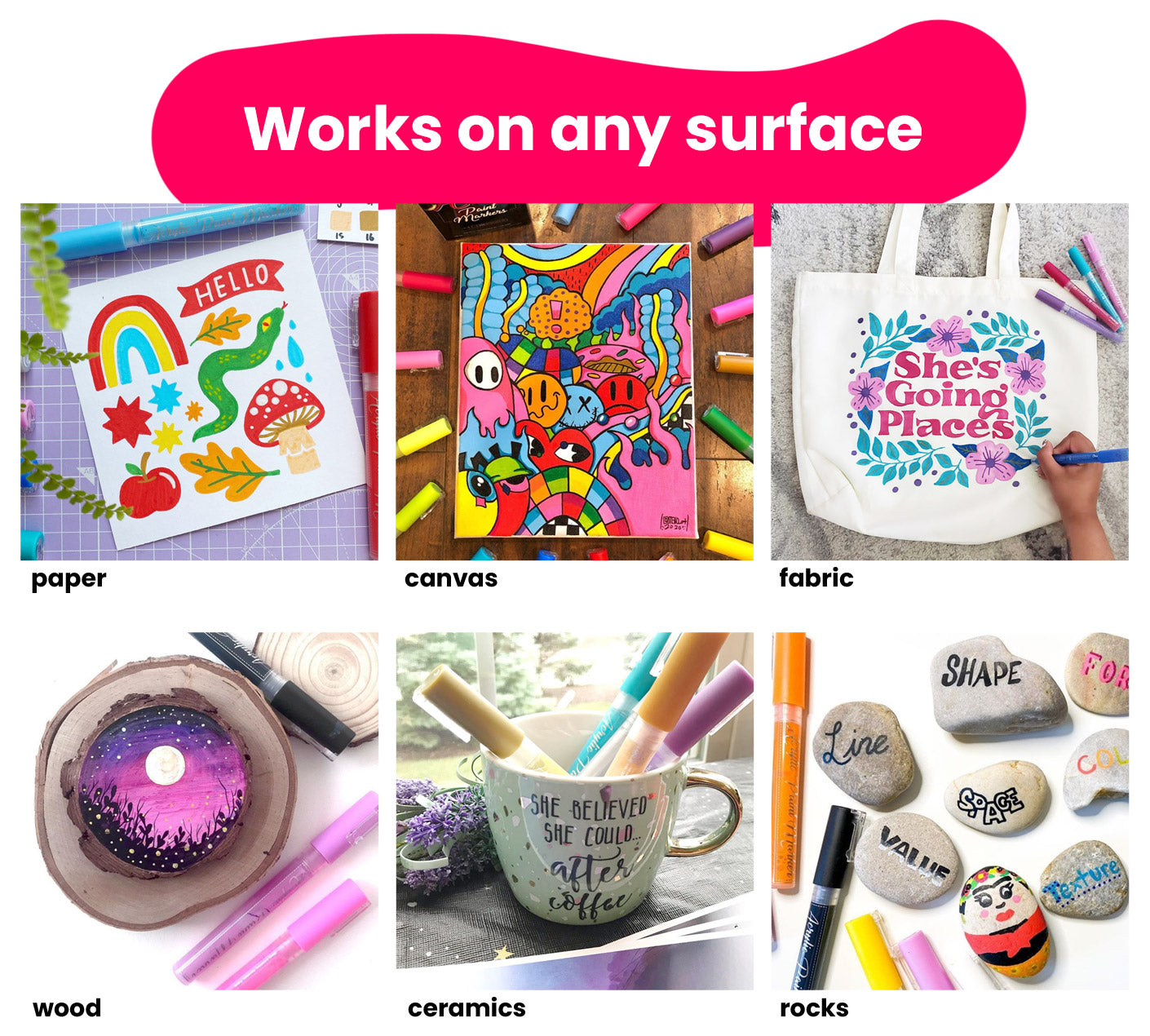
| Canvas / paper | Excellent — 100+ years | Acrylic's natural home; archival quality |
| Wood (raw or sealed) | Excellent — 10+ years indoors | Add outdoor sealant for exterior use |
| Rocks / stone | Excellent — 5–10 years outdoors (sealed) | Seal for garden or trail placement; survives light rain un-sealed |
| Glass / ceramic | Good — needs bake or sealant for dishwasher | 300°F bake for 30 min makes dishwasher-safe |
| Metal | Good — with primer | Prime with rust-inhibitor for exterior use |
| Plastic | Moderate | Test first; polyethylene and polypropylene resist adhesion |
| Fabric (cotton, canvas) | Moderate — with heat-set | Iron 2–3 min on medium through a cloth after cure |
| Rubber / silicone | Poor | Paint peels off; not a good match |
| Oily / greasy surfaces | Poor | Clean with rubbing alcohol or skip |

Are they dishwasher safe?
Not automatically. Hand-wash is safe once cured (24 hours). For dishwasher durability, bake the finished ceramic or glass piece at 300°F for 30 minutes after full cure — this fuses the acrylic into the ceramic glaze.
Here's the bake process (for mugs, plates, glass ornaments):
- Paint the piece with acrylic paint markers. Let touch-dry 10 minutes, then fully cure 24 hours.
- Place in a cold oven. Set oven to 300°F (150°C). Don't preheat.
- Heat slowly up to 300°F. Once at 300°F, bake 30 minutes.
- Turn off the oven. Let the piece cool inside the oven — don't thermal-shock by removing hot.
The slow-heat approach prevents cracking and ensures the paint cures without air bubbles. After baking, the mug is top-shelf dishwasher safe. Not all surfaces take this well — fine glazed porcelain is ideal; cheap glass and thin ceramic may crack under thermal stress.
Are acrylic paint markers waterproof?
Yes, once fully cured. Acrylic polymer is water-resistant by nature — once the paint has cured into its final plastic film, water beads off rather than re-wetting the color.
Before cure, water re-dissolves the paint easily (which is why fresh mistakes wipe off with a damp cloth). After cure, water has no effect on the color. You can wash a cured acrylic-painted rock in a stream, expose it to rainstorms, or run it under a tap.
For extended water exposure — outdoor fountains, pool edges, bathroom items — apply a waterproof clear acrylic sealant on top of cured paint. The sealant adds a second moisture barrier and extends weather resistance by years.
On fabric: acrylic is water-resistant after heat-set (iron 2–3 min on medium through a cloth). Fabric items survive normal machine washing; hand-wash gives longest life.
Do acrylic paint markers work on fabric?
Yes — especially on 100% cotton and cotton-canvas. With proper heat-setting, the paint survives normal washing cycles for months to years.
The heat-set process:
- Paint your design. Let touch-dry 10 minutes, then fully cure 24 hours.
- Cover the painted area with a clean cotton cloth.
- Iron on medium-high heat (no steam) for 2–3 minutes. Keep the iron moving; don't stop on one spot.
- Let cool before wearing or washing.
For clothing that will see heavy wash cycles (tote bags, t-shirts), add a textile medium additive before or after painting. Mix a small drop of fabric medium with water and brush over the design before heat-set — this adds flexibility so the paint bends with the fabric without cracking.
Avoid: stretchy synthetic fabrics (polyester, spandex) — the paint will crack along stress lines.
When and how to seal
Sealing adds UV resistance, water resistance, and physical durability on top of the paint's natural permanence. When to seal:
- Outdoor projects — garden rocks, outdoor signs, mailbox art. Always seal.
- Frequently-handled items — mugs (hand-wash), plant pots, decorated tools. Seal for abrasion resistance.
- Dishwasher or food-contact items — paint + bake (300°F, 30 min) OR paint + food-safe clear epoxy for non-heated items.
- Fine art on canvas — optional; acrylic is already archival. Seal for extra UV protection and dust control.
Types of sealant:
| Sealant | Best for | Finish |
|---|---|---|
| Spray acrylic sealant (Krylon, Rust-Oleum) | Fast application, outdoor pieces, odd shapes | Matte, satin, or gloss |
| Brush-on acrylic varnish | Controlled coverage, fine art | Matte to gloss |
| Mod Podge | Paper / wood crafts | Slight glossy texture |
| Polyurethane (oil or water-based) | Maximum outdoor durability | Warm amber (oil) or clear (water) |
| Food-safe epoxy | Food-contact items without baking | Glossy, pour-thick |
Apply 2–3 thin coats 10 minutes apart rather than one thick coat. Let each coat touch-dry before the next. Fully cure 24 hours after the final coat.
Can you remove acrylic paint marker?
It depends when you catch it. Wet paint wipes off in seconds. Touch-dry paint scrubs off with warm soapy water and effort. Fully cured paint (24+ hours) is nearly permanent — you'll need solvents or painting over.
- Wet paint (first 5 minutes): wipes off easily with a damp cloth. No stain remaining.
- Touch-dry paint (10–60 min): scrubs off with warm soapy water, a mild abrasive sponge, and patience. May leave light staining on porous surfaces.
- Cured paint (24+ hours): nearly permanent. For hard surfaces, try isopropyl alcohol or acetone (nail polish remover) with a cloth. May damage the underlying surface. For porous surfaces (wood, paper, canvas), you cannot fully remove — paint over with white gesso and restart.
If you make a mistake on a project, wipe immediately with a damp cloth before it dries. Once it's dry, you're usually committed.
Frequently asked questions
Does acrylic marker permanent?
Yes, acrylic paint markers are permanent once fully cured (24 hours). The paint dries into a flexible, water-resistant polymer film that bonds to most hard surfaces. Touch-dry happens in 3–10 minutes but full permanence requires the 24-hour cure window for the acrylic polymer chains to cross-link.
Do acrylic paint markers wash out?
Not once fully cured. Wet or touch-dry paint wipes off with water; fully cured paint (24+ hours) does not wash off. On fabric, heat-set with an iron after cure for wash durability. Mugs survive hand-washing after cure and dishwasher-cycle after a 300°F oven bake.
How long do acrylic paint markers last?
Unopened markers stored upright and capped last 2+ years. With moderate use (30 min of drawing per session, 2–3 sessions per week), an opened marker lasts 2–4 months. White and black wear out first because they're used the most. Replaceable nibs extend marker life by 2–3×.
How do you seal acrylic paint markers?
Apply a clear acrylic sealant after the paint has fully cured (24 hours). Spray sealant (Krylon, Rust-Oleum) is easiest for complex shapes; brush-on varnish gives more control for canvas. Apply 2–3 thin coats 10 minutes apart. Polyurethane works for maximum outdoor durability; Mod Podge for paper crafts.
Do acrylic markers work on fabric?
Yes — especially on cotton and cotton-canvas. After painting and full cure, heat-set with an iron on medium-high through a clean cloth for 2–3 minutes. Heat-set paint survives machine washing for months to years. Use a textile medium additive for maximum flexibility and crack resistance.
Are paint markers water resistant?
Once fully cured, yes. Acrylic paint is water-resistant by nature — water beads off rather than re-wetting the color. Before cure, water re-dissolves the paint easily (which is why fresh mistakes wipe off). For extended water exposure like outdoor fountains, apply a waterproof clear acrylic sealant.
Does acrylic paint stay on rocks?
Yes — rocks are one of the best surfaces for acrylic paint markers. The paint bonds tightly to clean, dry stone and resists normal weather exposure. For outdoor placement (gardens, trails, kindness-rock drops), apply a clear acrylic sealant after full cure — extends durability to 5–10 years.
Will paint marker come off with water?
Only wet or touch-dry paint (within the first hour) comes off with water. Fully cured paint (24+ hours) is water-resistant and won't wash off. If you need to remove cured paint from a hard surface, use isopropyl alcohol or acetone — warm soapy water alone won't work on cured paint.
How do I remove dried acrylic paint marker?
On hard surfaces (glass, ceramic, metal, sealed wood): isopropyl alcohol or acetone with a cloth and scrubbing. On porous surfaces (raw wood, paper, canvas, fabric): cured paint cannot be fully removed — paint over with white gesso and restart. Always catch mistakes within the first 5 minutes while the paint is still wet.
Tools for your next project
Chalkola favorites — ready to ship.


