


Acrylic Paint Markers vs. Permanent, Chalk, and Alcohol Markers
Side-by-side comparison of four marker types — acrylic paint, permanent markers, chalk, and alcohol (alcohol-based). What each is good at, and a quick 'which marker for which project' picker.
0:22 · Chalkola channel · permanence + water resistance Q&A
What each marker type actually is
The four major marker categories differ in everything that matters — ink chemistry, surface behavior, permanence, opacity, and ideal use. Understanding which is which saves you from buying the wrong tool for your project.
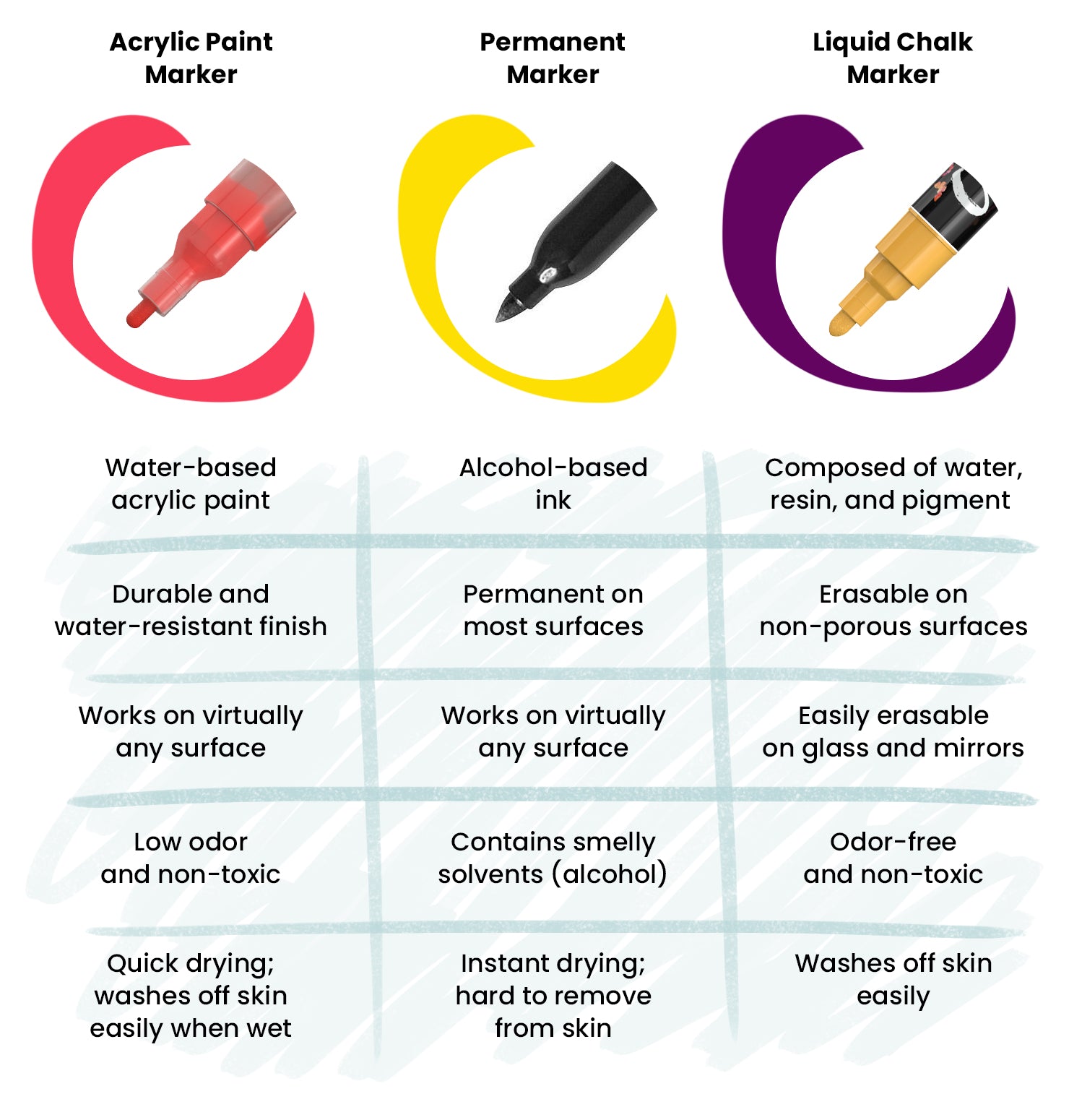
- Acrylic paint marker: pen-shaped bottle of water-based acrylic paint with a spring-valve nib. Opaque, permanent when dry, sits on top of the surface. Used for rock painting, wood signs, canvas detail, ceramics.
- Permanent marker: alcohol-based dye ink. Transparent, fast-drying, soaks into porous surfaces. Used for labeling, writing, temporary art.
- Chalk marker: water-based pigment ink. Erasable on non-porous surfaces (glass, whiteboards, chalkboards). Used for menu boards, window art, event signage.
- Alcohol marker: alcohol-based dye ink designed for illustration. Semi-transparent, blends beautifully on marker paper, not permanent on most hard surfaces. Used for comic art, manga, illustration.
Full four-way comparison table
| Acrylic paint | Permanent | Chalk | Alcohol-based | |
|---|---|---|---|---|
| Medium | Water-based acrylic | Alcohol-based dye | Water-based pigment | Alcohol-based dye |
| Opacity | Fully opaque | Transparent | Semi-opaque | Semi-transparent |
| On paper | Yes, permanent | Yes, bleeds | Yes, smudges | Excellent (marker paper) |
| On rocks / wood | Excellent | Fades fast | Washes off | Fades fast |
| On glass / ceramic | Excellent | Smudges, partial | Wipes off clean | No |
| On fabric | Good (heat-set) | Fades after wash | Washes out | No |
| UV resistance | Good (sealed: excellent) | Poor — fades in sun | Moderate | Poor |
| Archival quality | 100+ years | Years, not decades | Non-archival | Blending class only |
| Blendable | Wet-on-wet while fresh | Limited | No | Excellent |
| Color range | 20–40 colors | 30+ colors | 20–30 colors | 300+ colors |
| Typical cost per pen | $1–2 | $1 | $1–2 | $5–8 |
| Best for | Permanent art, signs, craft | Temporary marking, writing | Menu boards, windows | Comic art, illustration |
When to pick acrylic paint markers
Choose acrylic paint markers when the project needs opaque color that lasts for years on a hard surface — rocks, wood, glass, canvas, or metal.
- The project must last years or stay outdoors
- You're working on rocks, wood, metal, glass, plastic, or ceramic
- You need fully opaque color (especially light colors on dark backgrounds)
- You want to layer colors without earlier layers bleeding through
- The piece will be sold, gifted, or displayed long-term
Real-world examples: rock painting, DIY wood signs, ceramic mug decoration, canvas lettering, custom sneakers, plant pot decoration. See our full project ideas guide.
The waterproof demo at the top of this page shows a Chalkola acrylic-painted surface holding up under running water — proof the cured paint stays put.
When to pick permanent markers
Choose permanent markers when:
- You need text to bleed into a porous surface (cardboard boxes, fabric tags)
- Labeling something indoors that won't see direct sunlight
- You want a pen-like writing tool, not a paint-like body on the surface
- Cost is paramount and archival quality isn't critical
Where permanent markers fail: rocks, wood, and outdoor signage. The alcohol dye soaks in, fades under UV within weeks to months, and doesn't provide opaque color. For any permanent craft project, acrylic paint markers are the clear winner.
When to pick chalk markers
Choose chalk markers when:
- You want the mark to be erasable (menu boards, window art, event signage)
- The surface is glass, porcelain, chalkboard, or non-porous plastic
- The message will change frequently
- You want a matte, chalk-like aesthetic rather than glossy paint
Chalk markers and acrylic paint markers are opposites in permanence — chalk wipes off, acrylic stays forever. Don't confuse them. More on chalk markers: What Is a Chalk Marker?
When to pick alcohol markers
Choose alcohol markers for illustration work that needs seamless color blending on smooth marker paper — comic art, manga, concept sketches, and digital-style illustration on paper.
- You're drawing on dedicated marker paper
- Smooth color blending and gradients matter more than coverage
- You want 300+ colors for nuanced skin tones, shadows, and atmospheric work
- Quick studies, color roughs, and concept art where saturation is key
Alcohol markers are the weakest choice for hard surfaces — they can't stick to rocks, wood, glass, or metal. They're also much more expensive per pen ($5–8 vs $1–2 for acrylics). For illustration on marker paper, they're unmatched; for craft and signs, acrylic paint markers win.
Which marker for which project (30-second answer)
| Project | Best marker | Why |
|---|---|---|
| Rock painting | Acrylic paint marker | Only marker that stays opaque + permanent on stone |
| Wood signs (outdoor) | Acrylic paint marker + sealant | UV resistance and water protection |
| Menu board (re-writable) | Chalk marker | Wipes off when menu changes |
| Ceramic mug | Acrylic paint marker + bake | Dishwasher-safe after 300°F bake |
| Canvas illustration | Acrylic paint marker OR alcohol marker | Acrylic for opaque; alcohol for blends |
| Cardboard box label | Permanent | Bleeds into fiber, cheapest option |
| Comic art | Alcohol markers | Seamless blends, 300+ colors |
| Window display | Chalk marker | Erasable for seasonal changes |
| Metal car part | Acrylic + sealant | Best UV + solvent resistance among markers |
Frequently asked questions
Are tube acrylic paint and acrylic paint markers the same?
Same chemistry, different application. Both use water-based acrylic pigment that dries permanent. Tube acrylic is brushed on with infinite control over thickness, blending, and texture — best for paintings and large fills. Acrylic paint markers deliver the same paint through a controlled-flow nib, so they're better for fine detail, lettering, and projects where you don't want a brush load. Mix and match in the same piece.
Are all paint pens acrylic-based?
No. The "paint pen" category covers three different chemistries: acrylic-based (water-based, opaque, archival), oil-based (solvent-based, glossy, durable but with strong fumes), and alcohol-based dye markers (fast-drying but not true paint, prone to fading). Always check the label — only acrylic paint markers offer the "permanent + waterproof + non-toxic + works on any surface" combination.
What's the safest paint marker for kid-safe craft projects?
Acrylic paint markers with AP non-toxic certification. Look for ASTM D-4236 and EN-71 compliance on the label — these mean the marker has been third-party tested for safe craft use ages 6+. Avoid oil-based and alcohol-based paint pens for kid projects: solvent fumes and ingestion risk are real concerns.
Can a permanent marker do what an acrylic paint marker does?
No. Permanent markers use alcohol-based dye that fades in UV and soaks into porous surfaces. Acrylic paint markers use pigment that sits on top of the surface and stays opaque for years. For rock painting, wood signs, fabric work, or any outdoor or archival project, permanent markers fail where acrylic markers succeed. Permanent markers are for paper labelling — acrylic markers are for art that lasts.
Can I use chalk markers on rocks?
No — chalk markers use water-based pigment that wipes off with water. They're designed for erasable use on glass and chalkboards. For rock painting you need acrylic paint markers, which sit permanently on the stone surface and resist weather.
What is alcohol marker vs acrylic marker?
Alcohol markers use alcohol-based dye ink for blending illustration on marker paper. Acrylic markers use water-based acrylic pigment for opaque, permanent coverage on hard surfaces. Alcohol markers blend beautifully but don't stick to rocks/wood/glass; acrylic markers stick but don't blend as smoothly.
Can I combine these markers in one piece?
Yes — many crafters use permanent or alcohol markers for fine-line text and acrylic paint markers for opaque color blocks in the same piece. Let each type fully dry before painting over or near another. Don't expect chalk markers to coexist with the others — they'll wipe off when anything wet touches them.
Tools for your next project
Chalkola favorites — ready to ship.


