


What Is Watercolor Paint?
The chemistry and behavior of watercolor — what's in a tube, why it's transparent, and how it compares to acrylic and gouache.
What is watercolor paint made of?
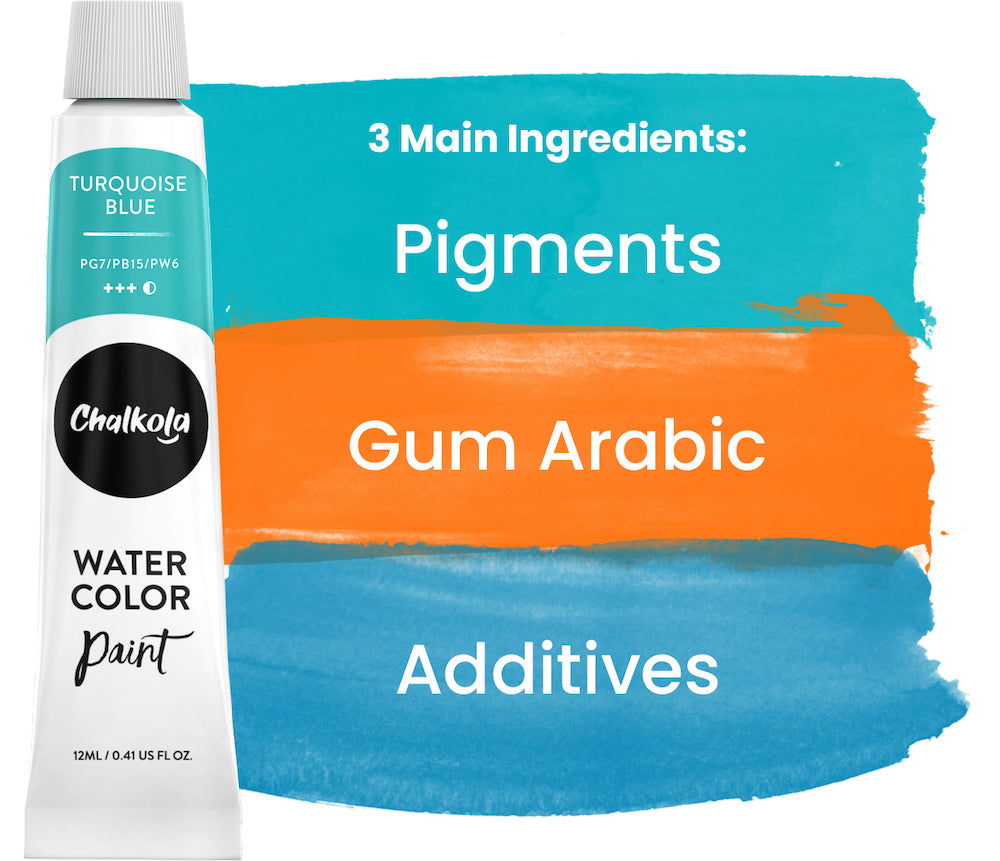
Watercolor paint is a simple four-ingredient formula: pigment, gum arabic binder, a humectant (glycerin or honey), and water with a small amount of preservative. The gum arabic dissolves in water, holds pigment to paper, and keeps the paint re-wettable forever.
- Pigment — the color, usually finely ground mineral or synthetic.
- Gum arabic — the binder. Tree sap (from acacia) that dissolves in water and holds pigment to paper.
- Glycerin and/or honey — humectants that keep pans from cracking and tubes moist.
- Water and a small amount of preservative.
When wet, watercolor pigment stays suspended in water. When dry, the gum arabic glues the pigment to paper. Because there's no plastic film (unlike acrylic), watercolor remains water-soluble after drying — you can re-wet and re-work it indefinitely.
Why is watercolor transparent?
Pigments are ground very fine and diluted heavily with water. Light passes through each layer, hits the paper, and bounces back to your eye — so colors appear "lit from within." Layer two transparent colors and they optically mix on the page, not on the palette.
Adding white paint to watercolor kills the transparency — which is why traditional watercolors have no white pigment. The white is the paper showing through. Once you cover paper with opaque paint, it's no longer watercolor; it's gouache or acrylic.
Pans, tubes, and liquid watercolor
Pans
Dried cakes in metal or plastic tins. Activated by a wet brush. Compact, travel-friendly, last years.
Tubes
Moist paste. Squeeze into a palette well and activate with water. More pigment per stroke, better for large washes.
Liquid watercolor
Pre-mixed liquid dye in a bottle. Very vibrant, often used in illustration. Less lightfast than pan/tube watercolor.
Beginners usually start with pans (cheaper, travel-ready). Serious watercolorists often switch to tubes for studio work and keep pans for travel.
What are watercolor paints used for?
Watercolor is the paint of choice for illustrators, botanical artists, urban sketchers, travel journalers, calligraphers, and plein-air landscape painters. The medium is used for:
- Illustration — children's books, scientific illustration, editorial work.
- Botanical studies — translucent petals and delicate leaves are watercolor's native subject.
- Urban sketching and travel journaling — a tin palette + water brush fits in a pocket.
- Landscape painting — atmospheric skies, mist, and distance are easier in watercolor than any other medium.
- Lettering and calligraphy — brush pens with water-blendable ink bridge between watercolor and ink.
- Portrait studies — softer, more forgiving than oil for quick figure work.
Watercolor vs. gouache
Gouache is watercolor's opaque cousin. Same binder (gum arabic), same cleanup (water), but gouache has added chalk and more pigment so it covers opaquely rather than transparently. Gouache dries matte and flat — closer to a flat poster-paint finish.
Both are common in illustration. Watercolor is chosen for atmosphere and glow; gouache for flat color and detail. Many artists use both in the same piece.
What is the main difference between acrylic and watercolor paint?
Watercolor uses gum arabic binder that stays water-soluble forever, so dried paint re-wets. Acrylic uses plastic polymer binder that cures permanent — once dry, it's locked. Watercolor is always transparent; acrylic can be transparent or opaque depending on dilution.
- Binder: gum arabic (watercolor) vs. plastic polymer (acrylic).
- Dried behavior: re-wettable (watercolor) vs. permanent (acrylic).
- Transparency: always transparent (watercolor) vs. adjustable (acrylic).
- Surface: watercolor paper only; acrylic on almost any surface.
- Cleanup: water (both).
Is watercolor paint waterproof?
No — traditional watercolor is never truly waterproof. The gum arabic binder stays water-soluble forever, which is the whole point of the medium. Spray a watercolor painting with water and the paint will lift, blur, or run. That's a feature, not a bug — it's why you can re-wet and rework watercolor indefinitely.
If you need a watercolor painting to survive moisture, seal the finished piece with a light coat of spray fixative or frame it behind glass. Gouache and acrylic are both more water-resistant than watercolor once dry.
Frequently asked questions
What is watercolor paint made of?
Watercolor paint contains four main ingredients: pigment, gum arabic (the binder, from acacia tree sap), glycerin or honey (humectants that keep paint workable), and water with a small preservative. That's the full chemistry — simple, non-toxic, and unchanged for centuries.
What are watercolor paints used for?
Watercolor is the go-to for illustration, botanical studies, urban sketching, travel journaling, landscape painting, lettering, and portrait studies. Its portability and glow make it the preferred medium for on-location work, while its softness suits delicate subjects like flowers and faces.
Can I reactivate dried watercolor?
Yes — that's unique to watercolor. Add water to dried paint on a palette, in a pan, or even on finished paintings, and it dissolves again. This is useful for editing, but means layers can lift each other if you're not careful. Let each layer dry fully before glazing over it.
Why do watercolors look lighter when they dry?
Wet watercolor contains suspended pigment that scatters light; dry paint has only pigment on paper. Expect colors to dry 30–50% lighter than they look wet. Mix slightly darker than your target shade, and resist the urge to add more pigment while the wash is still wet.
Is gouache the same as watercolor?
No — gouache uses the same gum arabic binder but adds chalk for opacity. Gouache covers completely; watercolor is transparent. Gouache dries matte; watercolor dries with a slight sheen. They play well together: you can use gouache highlights on a watercolor painting or mix them throughout a piece.
What's the difference between honey-based and standard watercolor?
Honey-based watercolors use honey as the humectant instead of (or alongside) glycerin. The honey keeps paint workable longer when wet, makes it slightly easier to re-wet from a dry palette, and gives the colour a soft buttery flow. The trade-off: honey-formulated paint can attract dust if uncovered for long periods. Standard glycerin-based watercolors (the most common formulation) handle dryness better and are easier to ship and store.
Tools for your next project
Chalkola favorites — ready to ship.

