


The Origins of Watercolor
From cave paintings to Turner's sunsets — a short timeline of the oldest paint medium in human history.
Prehistoric beginnings
The earliest pigment-on-surface paintings are cave art from roughly 40,000 years ago — ocher and charcoal mixed with water and animal fat, applied with fingers or reed brushes. These cave paintings were essentially the first watercolors: ground pigment plus a water-based binder on an absorbent natural surface.
Egyptian papyrus and Chinese silk
Egyptian funerary manuscripts (Book of the Dead, c. 1500 BCE) were illuminated with water-based paints on papyrus — egg yolk or gum arabic as binder, mineral pigments for color. Chinese artists were painting with water, ink, and pigment on silk from at least the Han dynasty (200 BCE–200 CE), developing techniques that influenced both Eastern and Western watercolor traditions.
Illuminated manuscripts
Throughout the European Middle Ages (c. 500–1400), water-based paint on parchment was the standard for illustrated manuscripts — the Book of Kells, the Lindisfarne Gospels, thousands of monastic Bibles. Scribes mixed mineral pigments with egg-white or gum arabic and applied them with reed pens and brushes. This is arguably the direct ancestor of modern watercolor technique.
Albrecht Dürer and the rise of watercolor painting
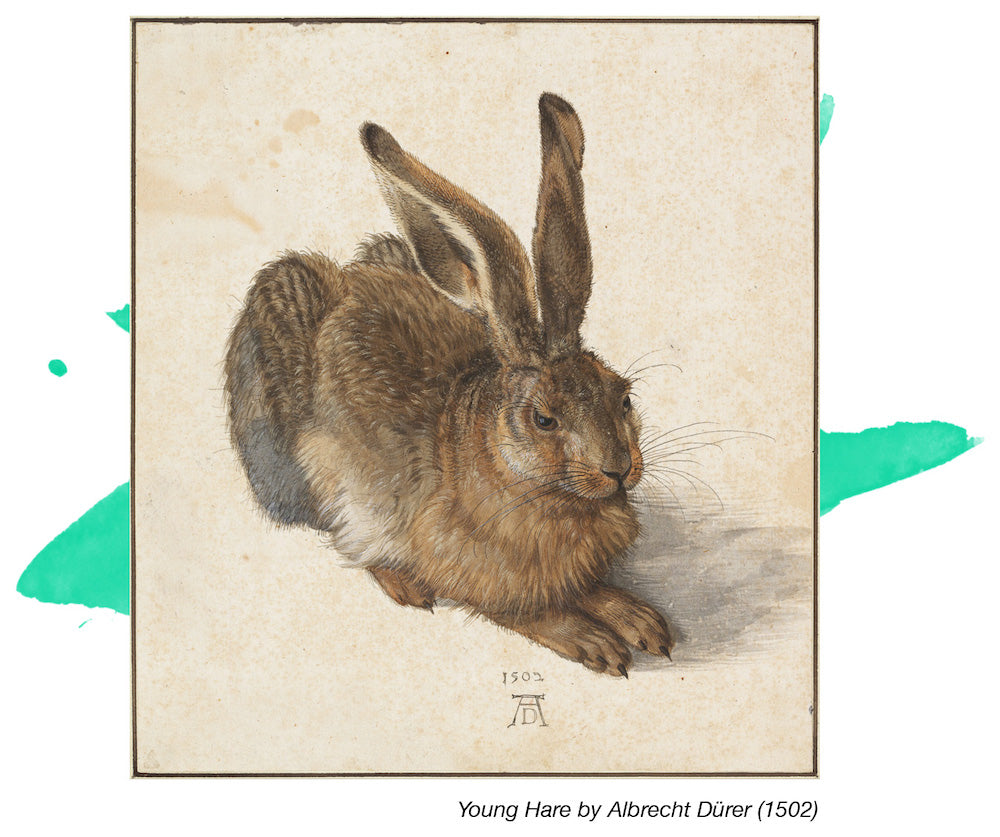
German Renaissance master Albrecht Dürer (1471–1528) is often called the father of modern watercolor. His landscape studies — alpine scenes, plants, hares, butterflies — used transparent water-based pigment on paper with startling realism and detail. Dürer's "Young Hare" (1502) remains one of the most famous watercolor works in art history, its fur painted hair-by-hair in translucent layers.
The British watercolor tradition
In the 18th century, watercolor became associated with British landscape painting. Artists like Paul Sandby (1731–1809), "the father of English watercolor," and Thomas Girtin (1775–1802) developed a tradition of plein-air landscape watercolor sketching that influenced artists across Europe. The Royal Society of Painters in Watercolours was founded in 1804, cementing watercolor as an institutional fine-art medium.
J.M.W. Turner and Romantic watercolor
J.M.W. Turner (1775–1851) took watercolor to its atmospheric peak. His seascapes and sunsets used transparent layers and wet-on-wet washes to capture light and weather in ways oil couldn't match. Turner painted thousands of watercolors — many discovered posthumously — and established watercolor as a major, not minor, fine-art medium. His bequest to the nation (now at Tate Britain) runs to over 30,000 watercolors and sketches.
Modern watercolor: Homer, Sargent, and beyond
American watercolorists Winslow Homer (1836–1910) and John Singer Sargent (1856–1925) pushed watercolor toward bold, expressive strokes and rich color. Homer's Caribbean seascapes and Sargent's Venetian architectural studies are modern watercolor at its most confident. Andrew Wyeth in the mid-20th century brought watercolor to quiet rural realism with his Helga Pictures series.
Did Klimt use watercolor? Yes — Gustav Klimt used watercolor for preparatory sketches and smaller works, though he's better known for oil paintings with gold leaf. Did Edvard Munch use watercolor? Yes — Munch frequently worked in watercolor and tempera, especially for studies leading to his famous oils.
Today watercolor is enjoying a strong revival among urban sketchers, botanical illustrators, travel journalers, and abstract artists. Modern pigments, papers, and portable kits make the medium more accessible than ever.
Frequently asked questions
Who invented watercolor painting?
Watercolor wasn't invented — it evolved. Water-based pigment painting dates to prehistoric cave art 40,000 years ago. The formal European watercolor tradition is often traced to Albrecht Dürer in the 1500s, with the British school (18th–19th century) cementing watercolor as a major fine-art medium via Paul Sandby, Girtin, and Turner.
When was watercolor invented?
Water-based pigment painting is at least 40,000 years old (prehistoric cave paintings used water + ocher + charcoal). The medium as we know it — portable gum-arabic-bound watercolor in pans and tubes — developed in 18th-century Britain, with commercial pans introduced around 1781 by Reeves.
Who is the most famous watercolor artist?
J.M.W. Turner is widely named the greatest watercolorist in history, followed by Winslow Homer, John Singer Sargent, Andrew Wyeth, and Albrecht Dürer. Today, urban sketcher Paul Heaston, botanical illustrator Billy Showell, and loose-style painter Alvaro Castagnet are influential modern voices.
Is watercolor older than oil painting?
Yes, by tens of thousands of years. Oil painting was invented in the 15th century (~1400s, credited to Jan van Eyck and the Flemish Primitives). Water-based pigment painting dates to cave art 40,000 years ago, with formal Egyptian water-based works from around 1500 BCE.
Did Klimt or Munch use watercolor?
Yes — both used watercolor. Gustav Klimt used watercolor for preparatory sketches and smaller works. Edvard Munch used watercolor and tempera frequently, especially for studies leading to his famous oil paintings. Both are primarily remembered for oils, but watercolor was a working medium for both.
What are the oldest surviving watercolor paintings?
Egyptian Book of the Dead manuscripts from around 1500 BCE are the oldest intact water-based paintings on portable supports (papyrus). Much older prehistoric cave paintings (Chauvet ~36,000 BCE, Altamira ~18,000 BCE, Lascaux ~17,000 BCE) use water-based pigments but aren't on portable supports.
Tools for your next project
Chalkola favorites — ready to ship.

