


What Is a Glass Desktop Whiteboard? The Complete Guide
Tempered glass + built-in storage, in one desktop fixture. How glass desktop whiteboards work, why they beat paper and melamine, and what to look for.
Glass desktop whiteboard, in one sentence
A glass desktop whiteboard is a tempered-glass writing surface that sits flat on your desk — usually between your keyboard and monitor — where you write dry-erase notes, to-do lists and reminders that you can wipe clean without a trace.
Unlike the melamine or plastic whiteboards that hang on walls and start ghosting after a few weeks, the writing surface here is a single sheet of tempered safety glass. Glass is non-porous, meaning dry-erase ink never soaks in — it sits on top and wipes off with a dry cloth, every time, for years. The boards are usually 12–16 inches wide, 5–8 inches deep, and 1–2 inches tall — small enough to fit on any desk, tall enough to lift your keyboard to a healthier typing angle.
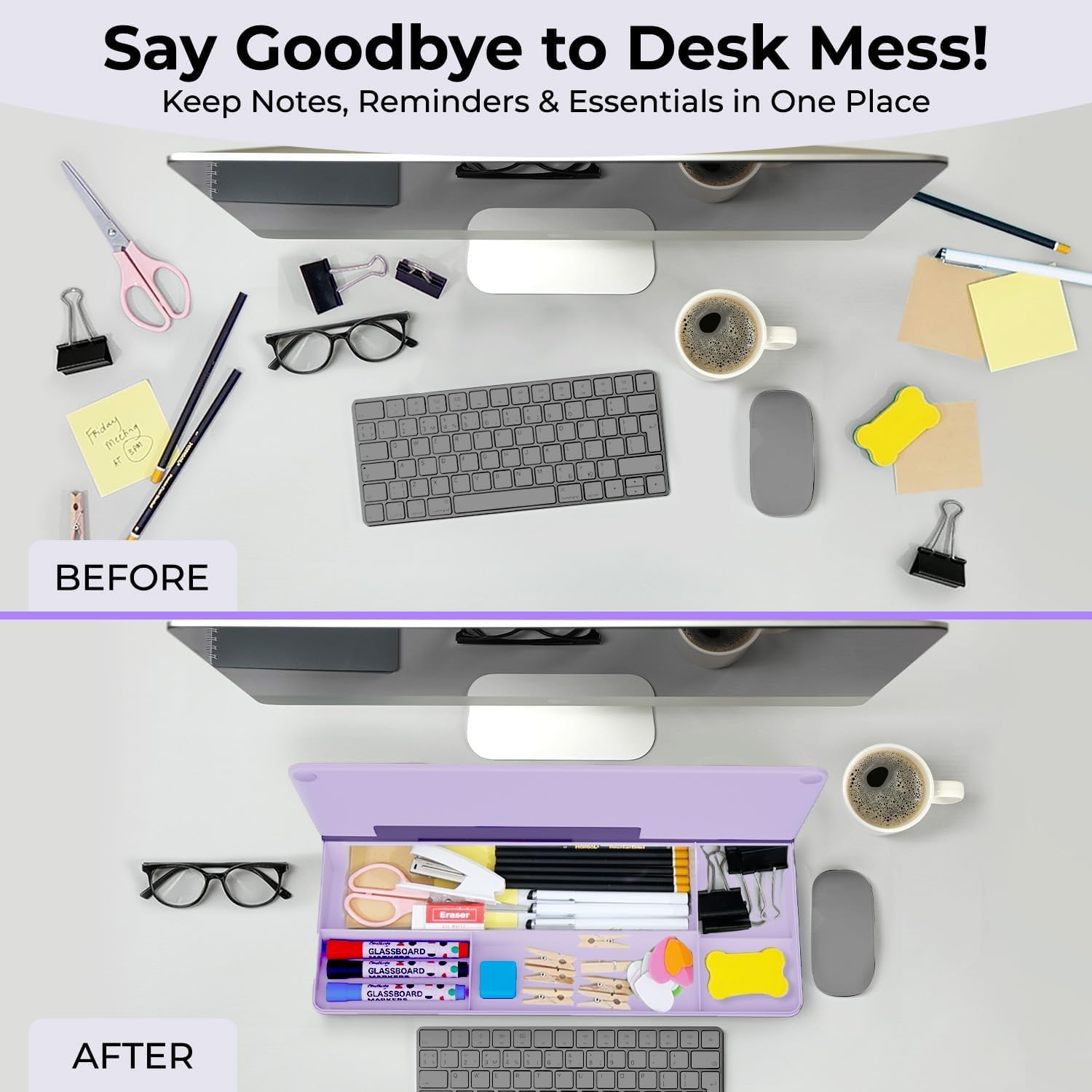
Most glass desktop whiteboards (including ours — the Chalkola GlassDesk Organiser) pair the glass writing surface with a built-in storage tray underneath. Five compartments hold your pens, sticky notes, paper clips, AirPods, cables — the stuff that usually spreads across your desktop.
Tempered glass = no ghosting
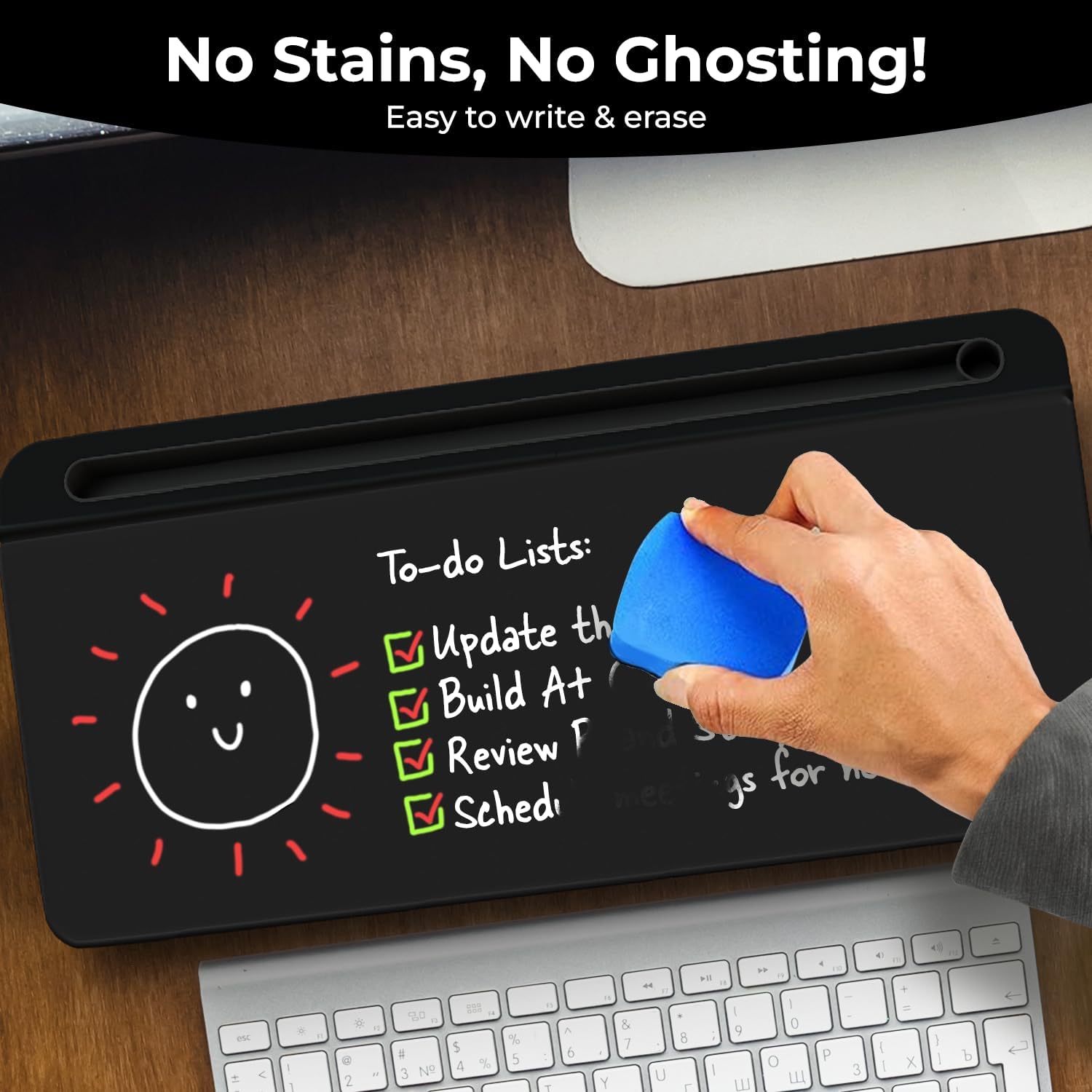
Old wall whiteboards stain after a few months. Glass is non-porous, so dry-erase ink wipes off completely, every time, forever.
Built-in storage
Our GlassDesk has 5 compartments for markers, clips, sticky-note stacks, flash drives. The board IS the organiser.
Doubles as a keyboard riser
The 2-inch profile puts your keyboard at a better typing angle. Anti-slip pads keep it still.
How does a glass whiteboard work?
Glass whiteboards work because tempered glass is non-porous — dry-erase ink sits on the surface instead of soaking in. When you wipe the glass, the pigment lifts off completely, leaving zero shadow or stain.
Here's the science:
- Dry-erase ink chemistry. Dry-erase markers contain three parts: pigment (the colour), a release agent (usually silicone-based), and a carrier solvent. The release agent's job is to keep the pigment from bonding to the surface underneath.
- Glass is smoother than plastic. Even a melamine or painted-steel board has microscopic pits in its finish. Ink pigment gets lodged in those pits, and that's what causes the faint shadow (ghosting) on old whiteboards. Tempered glass is mirror-smooth at a microscopic level, so there's literally nowhere for the pigment to stick.
- Tempered for safety. Chalkola's GlassDesk uses 4mm tempered glass — 4–5× stronger than regular glass. Even if dropped, tempered glass shatters into small rounded pebbles rather than jagged shards, similar to a car windshield.
The result: you can write with any dry-erase marker, wipe with a dry cloth, and the surface looks brand new. Permanent-marker residue (the classic kid mistake) lifts with a dab of isopropyl alcohol.
What's the difference between a whiteboard and a glass whiteboard?
A regular whiteboard has a melamine or painted-steel surface that absorbs marker pigment over time. A glass whiteboard has a non-porous tempered-glass surface that never absorbs — so it never ghosts or stains.
| Glass desktop whiteboard | Melamine board | Porcelain steel board | Painted steel board | |
|---|---|---|---|---|
| Surface | Tempered glass | Resin-coated fiberboard | Porcelain-enamel on steel | Painted steel |
| Ghosting | None | Starts in 3–6 months | Minimal | Rapid |
| Stains on permanent ink | Wipes with alcohol | Permanent | Wipes with alcohol | Permanent |
| Lifespan | 10+ years | 1–3 years | 20+ years | 1–2 years |
| Feel when writing | Smooth, almost glassy (unsurprisingly) | Slight drag | Smooth | Sticky |
| Scratch-resistance | Excellent | Poor | Excellent | Poor |
| Typical price range | $20–$35 desktop | $15–$30 desktop | $60+ wall-mount | $10–$20 |
The short version: if you're buying a desktop board you'll use every day for the next decade, glass wins on longevity and aesthetics. The price difference over the life of the product is basically zero.
Is a glass whiteboard worth it?
For daily desk use, yes — a glass whiteboard pays for itself in 6–12 months by outlasting the plastic boards that ghost and need replacing. The durability + zero-ghost surface makes it a one-time buy.
When a glass desktop whiteboard is worth it:
- You're at your desk 4+ hours a day. The better writing surface is a small daily dopamine hit — smoother writing, cleaner erases, nicer aesthetic.
- You've replaced a whiteboard before because it ghosted or got scratched. That problem doesn't happen on glass.
- You want a desk organiser + whiteboard in one. Buying them separately costs more than our GlassDesk, which combines both.
- You share your desk view on Zoom or streams. Glass looks premium on camera; melamine looks cheap.
When a glass board is not worth it:
- You write on a whiteboard twice a month.
- You need a huge wall-sized board for brainstorming — glass wall-boards exist but get expensive fast ($300+ for 4'×3' sizes).
- You're furnishing a classroom on a tight per-desk budget and need 30 of them.
Why a glass desktop whiteboard with storage makes more sense than two separate things
The reason we built the Chalkola GlassDesk Organiser as a combined unit, not a separate board + caddy: most people waste desk real estate by doubling up.
A typical pre-GlassDesk setup:
- Pen cup (3×3×4”)
- Sticky-note pad (4×4×0.5”)
- Paper-clip dish (3×3×0.5”)
- Desk pad or mousepad (15×10”)
- Small whiteboard (if any) leaned against the monitor
Total footprint: ~150 sq inches across 4–5 items, all in your line of sight, none talking to each other.
The GlassDesk footprint: 16×7 = 112 sq inches. The compartments replace the pen cup and clip dish. The board replaces sticky notes for reminders. The keyboard riser replaces (some of) the desk pad. The board fits BETWEEN your keyboard and monitor, so it's using space that was empty before.
You get a dry-erase board, a pen organiser, a paper-clip dish, and a keyboard riser for the footprint of one desk pad and 1/3 the cost of buying them separately.
Who uses a glass desktop whiteboard?
Remote workers & WFH professionals
Top-3 priorities of the day, current sprint tasks, meeting agenda, phone-call notes. Everything glanceable at your monitor level.
Students & teachers
Homework plan, math practice, flashcard quizzes, class-prep lists. Replaces paper planners for anyone who prefers to wipe-and-rewrite.
Creators & streamers
Stream schedule, upload deadlines, social-post copy. Looks clean on webcam. Neon green variant pairs well with RGB setups.
People with ADHD / executive-function struggles
The “external brain” benefit: getting priorities out of your head and onto a visible glass surface in front of you. Nothing to scroll or swipe past.
Small-office owners
Shift schedules, daily task lists, quick price-checks at a cash wrap — the small-footprint board beats a wall-mounted whiteboard in tight spaces.
Engineers, designers, thinkers
Sketching diagrams, jotting equations, doodling through a stuck problem — a tactile thinking tool that paper can't replace.
Next up: how people actually use theirs every day.
Do glass whiteboards break easily?
Glass desktop whiteboards use 4–6 mm tempered safety glass — 4–5× stronger than regular glass. Tempered glass is the same material used in car windshields and smartphone screens. It does not shatter on everyday drops from desk height.
What makes tempered glass safe:
- Heat-tempering process. Glass is heated to ~620°C and rapidly cooled, creating compressive stress on the outer layers and tensile stress in the core. This is what gives tempered glass its impact resistance.
- Shatter pattern. If tempered glass ever does break (from extreme force), it fragments into small rounded pebbles instead of sharp shards — the same behaviour you see when a car side window breaks.
- Everyday resilience. Our GlassDesk is rated to handle being knocked off a desk, having objects dropped on it, and being leaned on. What it can't survive: a direct hammer strike or being dropped edge-first onto a tile floor.
Tempered glass is safe for normal desk use, but it's still glass. We rate the GlassDesk for ages 12+. For younger kids, look at our dot markers or watercolor set instead.
Disadvantages of glass whiteboards (the honest section)
We built these — we'll tell you where they fall short.
| Tradeoff | Why it matters | Our mitigation |
|---|---|---|
| Heavier than plastic | The glass + storage tray weighs ~3 lbs. Not ideal for travelling or carrying between offices. | We designed the GlassDesk as a stays-put desk fixture. For a portable board, we'd recommend a paper memo pad instead. |
| Marker choice matters | Some cheap dry-erase markers (especially ones with alcohol-based ink) can smear on glass until fully dry. | The GlassDesk ships with 3 glass-formulated markers. See our markers guide for what works. |
| Smaller than a wall board | 16×7 in is small. No room for a full project brainstorm. | By design. It's for daily to-dos + priorities, not mind mapping. Pair with a wall whiteboard if you need both. |
| Reflective surface | Glass reflects light — in direct sunlight or overhead lighting, you might see a glare. | Position at a slight angle or use the matte-black variant, which is less reflective. |
| Fixed colour | You pick a colour at purchase — can't swap later. | 8 colour variants to choose from (white, black, lavender, neon green, grey, blue, green, pink). Pick one you'll still like in 3 years. |
Honest take: for the specific use case of “a good-looking, durable, no-ghost writing surface I use every day on my desk,” we haven't found anything that beats tempered glass. But it's not a universal replacement for every whiteboard you might own.
Chalkola GlassDesk Organiser — 4 popular variants on Amazon
The Chalkola GlassDesk Organiser ships in 8 color variants — 4 of which are popular long-running SKUs with 378 reviews at 4.4★ on Amazon. Here are those 4 in detail.
Available exclusively at Chalkola's Amazon Store and on this site for the Lavender variant.

Chalkola Glass Desktop Whiteboard with Storage — White, 16×7 in Tempered Glass + 3 Glass Markers
- Premium tempered glass — smooth writing surface, stain-free, no ghosting even after months of daily use. Unlike the plastic boards that scratch and yellow, glass stays clean.
- 5 storage compartments — stash markers, pens, paper clips, sticky-note stacks, and small desk essentials in one minimalist tray. Ends the sticky-note pile on your monitor.
- Doubles as a keyboard stand — the 2" profile lifts your keyboard for better typing angle. Anti-slip pads keep it from sliding when you type.
- Ships ready to use — zero assembly. Arrives with 3 glass-formulated dry erase markers (black, red, green) + eraser. Also works with our 60-pack dry erase markers.


Chalkola Lavender Glass Desktop Whiteboard with Storage — 16×7 in + 3 Markers
- Soft lavender tempered glass — the same scratch-resistant surface in a warm pastel that works with bedroom, creative-studio, and feminine office aesthetics.
- 5-compartment storage tray houses markers, washi tape, stickers, clips, and stationery. The built-in organiser means no separate desk caddy needed.
- Keyboard riser + memo board in one — 16 inches wide, tall enough to clear most full-size mechanical keyboards. Anti-slip pads.
- Compatible with standard dry erase markers including our 60-pack and the 3 glass-formulated markers included in the box.


Chalkola Neon Green Glass Desktop Whiteboard with Storage — 16×7 in + 3 Markers
- High-visibility neon green glass — for creators, streamers, and gamers who want their desk kit to pop. Writes with the same clean dry-erase precision as our other variants.
- Pair with neon dry erase markers for a full statement setup. Our 60-pack dry erase markers include neon shades that show brilliantly against the bright backdrop.
- 5 storage compartments for pens, cables, AirPods, headphone plugs — a productivity tool that lives at eye level on your desk.
- Stain-free tempered glass — permanent-marker residue wipes off with isopropyl alcohol, unlike plastic boards which stain on contact.


Chalkola Black Glass Desktop Whiteboard with Storage — 16×7 in + 3 Markers
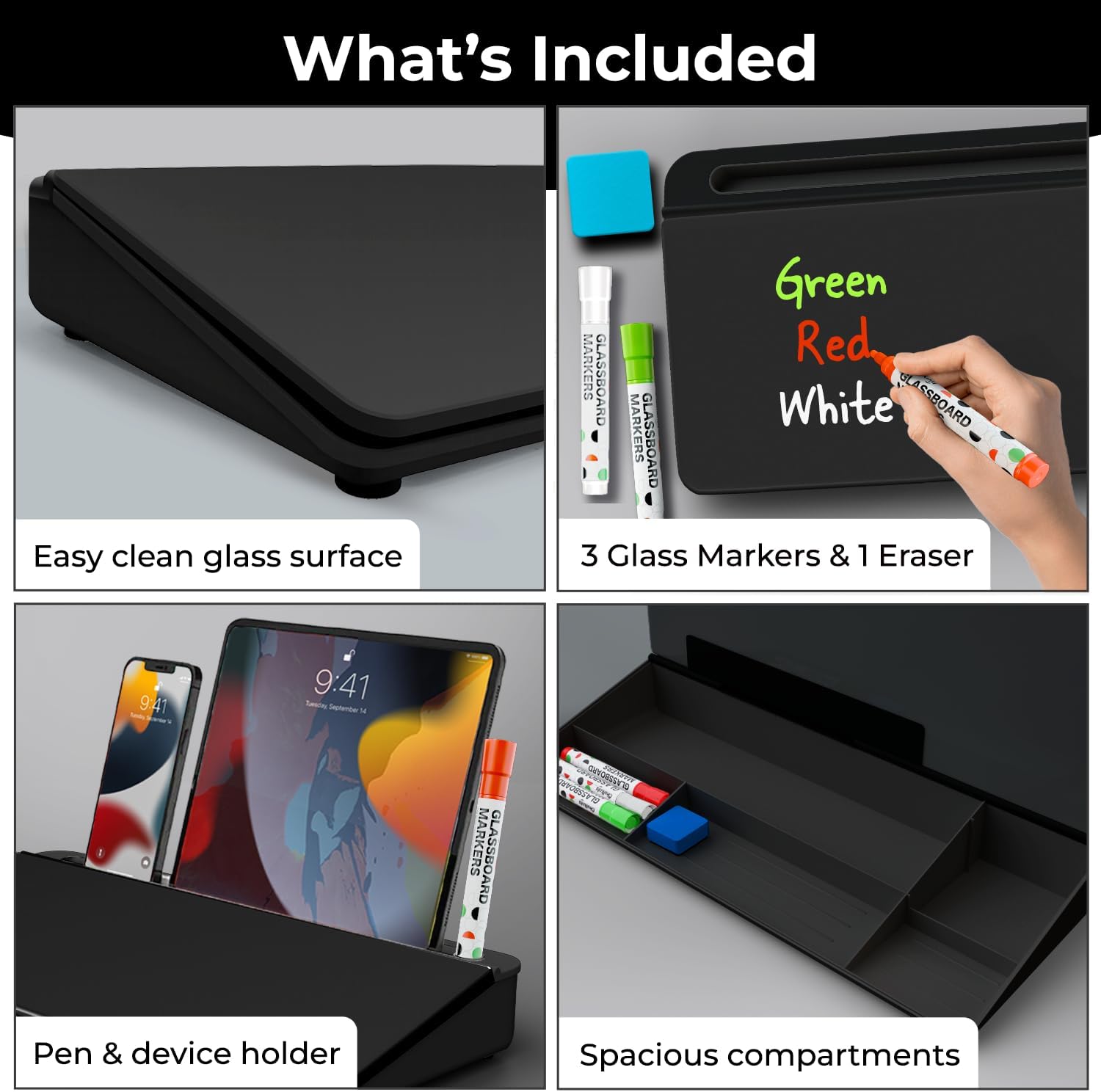
- Matte black tempered glass — the minimalist choice. Works as a chalkboard lookalike when paired with our liquid chalk markers for a café-sign aesthetic on your desk.
- Neon + metallic chalk markers show beautifully on the black surface — functionally the same as a classic blackboard, but with the clean-erase convenience of a whiteboard.
- 5 compartments for desk essentials — same 16×7 footprint as every Chalkola GlassDesk. Fits between any standard keyboard and monitor.
- Dry erase and chalk-marker compatible — the only desktop board in our lineup that takes both. Uses 3 white/red/green glass-formulated dry erase markers (included).

See the full GlassDesk product page for all 8 color variants, or browse dry erase markers that work best on glass.
Frequently asked questions
What is a glass desktop whiteboard?
A glass desktop whiteboard is a tempered-glass writing surface that sits on your desk (usually between keyboard and monitor) for dry-erase notes. The non-porous glass never absorbs marker ink, so it wipes clean every time without ghosting — unlike plastic or melamine boards that stain over months.
What's the difference between a whiteboard and a glass whiteboard?
A regular whiteboard uses a porous melamine or painted-steel surface that slowly absorbs marker pigment, causing ghosting and staining within 3–6 months. A glass whiteboard uses non-porous tempered glass that never absorbs ink — so the writing surface stays pristine for 10+ years of daily use.
Is a glass whiteboard worth it?
For daily desk use, yes. A glass desktop whiteboard pays back within 6–12 months versus plastic boards that need replacing due to ghosting and scratches. If you're at your desk 4+ hours a day, the smoother writing, cleaner erasing, and premium aesthetic make it a one-time buy rather than a consumable.
How does a glass whiteboard work?
Dry-erase markers contain a silicone-based release agent that prevents pigment from bonding to the surface. Tempered glass is mirror-smooth at a microscopic level, so ink sits entirely on top and wipes off with a dry cloth. Porous surfaces trap pigment in micro-pits — glass doesn't have any.
Do glass whiteboards break easily?
No. Glass desktop whiteboards use 4–6 mm tempered safety glass, which is 4–5× stronger than regular glass — the same material as car windshields. It survives normal desk drops and objects being dropped on it. In the rare case of extreme force, tempered glass fragments into small rounded pebbles, not sharp shards.
What are the disadvantages of glass whiteboards?
They're heavier than plastic boards (~3 lbs), work best with quality dry-erase markers (cheap ones smear on glass), and have a smaller footprint than wall boards. The reflective surface can cause glare in direct light. For the trade — 10+ year lifespan with zero ghosting — we consider these manageable for a daily-use desktop accessory.
What pens work on a glass whiteboard?
Standard dry-erase markers all work. The best results come from low-odour, glass-formulated markers (our GlassDesk ships with 3). Chalk markers also work on our black variant for a chalkboard aesthetic. Permanent markers will write but require isopropyl alcohol to fully remove — dry-cloth alone won't clear them.
Tools for your next project
Chalkola favorites — ready to ship.


