


Fun Ways to Learn With Dot Markers
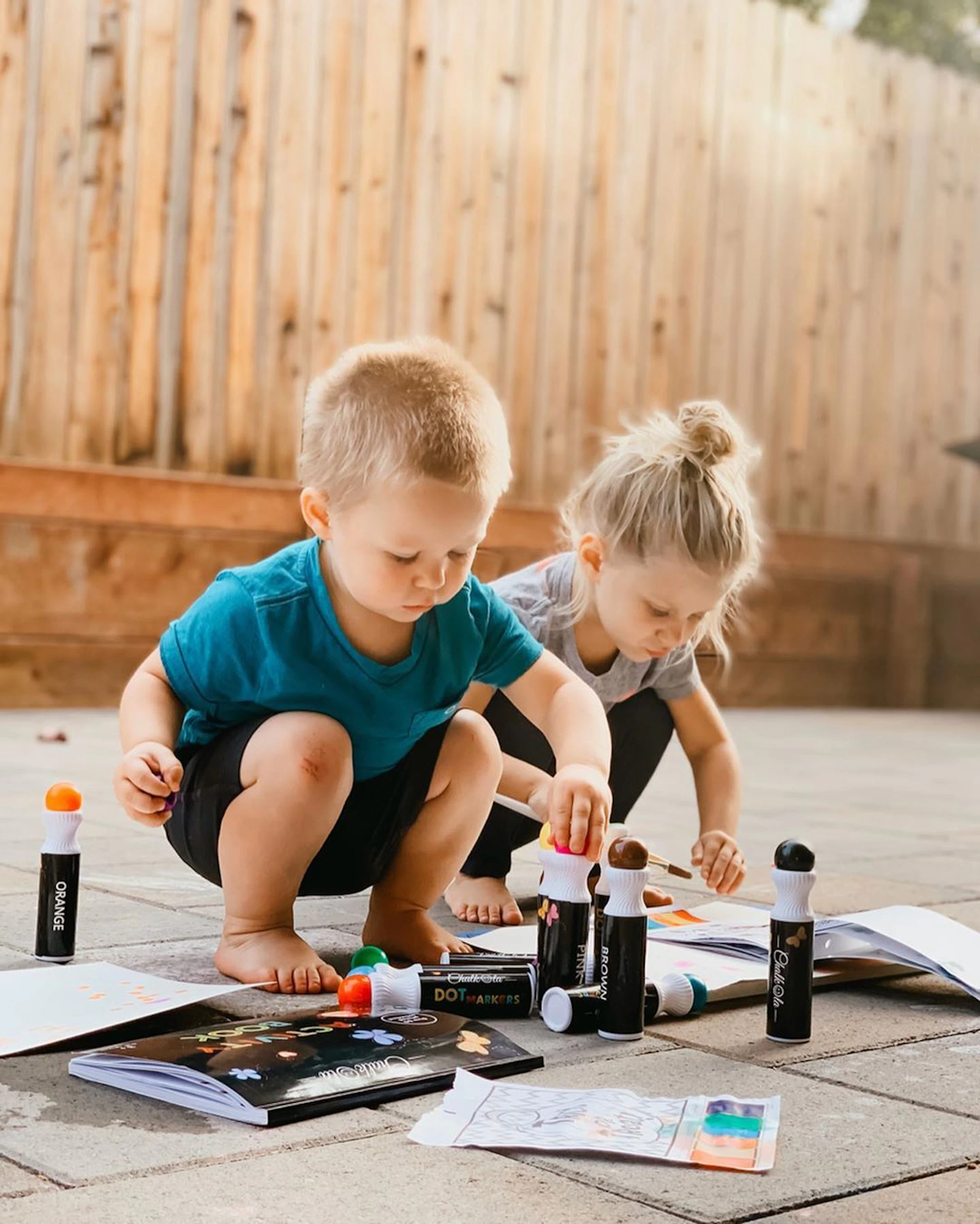
Twelve preschool-tested activities that turn a pack of dot markers (aka bingo daubers) into a portable early-learning curriculum.
Alphabet recognition
Print large outline letters (A-Z) and have kids fill each letter shape with dots. The repetition builds letter recognition; the fat dots stay inside the shape without pencil control. Variations: color-code consonants vs. vowels, or make each letter a different color.
Counting and number sense
"Dot the number 5 five times." Kids see the numeral, say it aloud, and physically count out the dots. Over weeks this builds cardinality (understanding that the last number counted = the total). Extend to 1–20 as skill grows.
Shape outlines and edges
Print basic shapes (circle, square, triangle, star, heart) large enough to dot the outline. Dotting around a shape trains visual tracking — kids' eyes follow the edge while their hand follows their eye. Foundational pre-reading skill.
AB, ABB, ABC pattern practice
Draw a row of 8 circles. Have a child dot them in alternating colors (red-blue-red-blue = AB pattern). Then ABB (red-blue-blue-red-blue-blue). Then ABC. Pattern recognition is a core pre-math skill and dot markers make it visible.
Primary + secondary color mixing
Overlap two wet dots and watch the mixing happen: red + yellow = orange, yellow + blue = green, blue + red = purple. Give kids a blank circle diagram and have them predict, then test. First experience of "I was right!" in a science-y way.
Weather and season tracking
Make a monthly calendar grid. Each day a child dots a weather-color: yellow for sunny, blue for rainy, white for snowy, gray for cloudy. By month-end they have a visual record that opens conversations about weather patterns and seasons.
Fine motor skill building
Dotting small circles (1 cm or less) requires precision. Build up from giant circles (5 cm) to tiny ones over weeks. Watching a toddler progress from dot-anywhere to dot-on-target shows visible fine motor development.
Mapping and location
Print a simple world or US map. Use dots to mark: where you live (red), places you've visited (blue), places you want to visit (yellow). Introduces spatial reasoning and a first sense of geography.
Name recognition
Print each child's name in large bubble letters. Have them dot-fill their name — their own name in color is a high-motivation task. Repeating it across a week cements letter order.
Emotions and feelings chart
Make a simple five-emotion chart (happy, sad, tired, angry, excited). Each day a child dots next to how they feel. Builds emotional vocabulary and gives adults a check-in tool.
Color sorting
Print a page with mixed colored circles and 4 buckets (one per color). Kids "sort" by dotting each circle over its matching bucket. Builds classification skills — the foundation of later taxonomy and categorization thinking.
Storytelling prompts
Dot a picture of a character (fish, bug, butterfly) with patterns the child invents. Then ask "What's your character's name? Where does it live? What's it doing?" Dot-markering as a springboard to narrative vocabulary.
Frequently asked questions
What age range benefits most from learning activities with dot markers?
Ages 2–6 gain the most. Under 2 is free-dot play. Ages 3–4 are the sweet spot for pre-literacy and color-sorting work. Ages 5–6 use dot markers for letter-writing practice, number operations, and more complex pattern work.
Where can I find printable dot marker worksheets?
Search 'do a dot printables' on Google or Pinterest — tens of thousands of free pages exist. Teachers Pay Teachers has curated bundles. Sites like 123 Homeschool 4 Me and This Reading Mama offer seasonal themed packs for any age.
Can I use dot markers for homeschool kindergarten?
Yes — they're a common homeschool supply, especially for handwriting prep, letter recognition, and math manipulatives. Most homeschool curricula for ages 3–5 include 1–2 dot-marker activities per week.
What if my child just wants to scribble with the dot markers?
That's fine — free play has value. Rotate between structured worksheets (30% of time) and free pages (70%). The structure teaches concepts; the free time builds joy. Both matter.
Tools for your next project
Chalkola favorites — ready to ship.


