


Fine vs Chisel vs Extra-Fine Dry Erase Marker Tips
The complete tip-size decision guide for dry erase markers — chisel for classrooms, fine tip for planners, extra-fine for tight grids. With a 3-question decision matrix for picking the right size for your use case.
The three dry erase marker tip sizes
Dry erase markers come in three tip sizes: chisel (5 mm wide, most common), fine tip (1.5 mm, pen-like), and extra-fine (0.7 mm, ultra-thin). Pick based on where you're writing and how big your letters need to be.
Chisel tip (5 mm wide)
The default. Flat angled nib gives a 5 mm wide headline stroke held flat, 2 mm handwriting stroke held upright. One marker does both sizes.
Fine tip (1.5 mm)
Writes the size of a ballpoint pen. Best for dry-erase planners, laminated charts, detailed diagrams, and student homework practice.
Extra-fine (0.7 mm)
Ultra-thin line for tight grids — desk-sized dry-erase calendars, crossword puzzles on laminated sheets, map annotations.
How to pick the right tip size (3-step decision)
Three questions decide it:
1. How big is your writing surface?
- Standing whiteboard (3+ feet wide): chisel tip. Anything smaller disappears from 10 feet away.
- Desktop / handheld whiteboard (under 2 feet): fine tip works well; chisel also fine.
- Small laminated sheet (8.5×11 or smaller): fine tip or extra-fine.
- Dry-erase planner (letter-size or smaller grid boxes): fine tip or extra-fine.
2. Who will read it, from how far away?
- A room of 25+ students / meeting attendees (10+ ft away): chisel, always.
- Yourself and 1-3 others (within 6 ft): fine tip.
- Yourself (your own desk): fine tip or extra-fine.
3. What's your primary use?
- Teaching, presentations, big brainstorms: chisel
- Weekly planning, to-do lists, laminated charts: fine tip
- Calendars, crosswords, detailed notes: extra-fine
Why chisel tip is the classroom default
Chisel-tip markers give you two stroke widths in one marker — you don't need to switch between a headline pen and a body-text pen.
- Held flat (wide edge down): 5-6 mm stroke width. Perfect for headings, bullet dashes, highlighting boxes, underlines.
- Held upright (tip point down): 2-3 mm stroke width. Perfect for handwriting, numbers, punctuation.
- Tilted 45°: 3-4 mm stroke width. The calligraphic middle ground.
For classroom use, a teacher writes an H2 header with the flat edge, then rotates the marker for handwriting without switching markers. Chalkola's 60-pack chisel tip markers are our bestseller for this reason.
When fine tip is the right choice
Fine tip dry erase markers (1.5 mm stroke) are underrated and often the correct choice for non-classroom use. The stroke is the same width as a ballpoint pen, which means:
- Dry-erase planners work. Planner grid boxes are sized for pen, not for 5 mm chisel strokes. Fine tip keeps writing inside the lines.
- Laminated charts stay readable. Chore charts, habit trackers, and meal planners fit much more content.
- Student homework practice. Kids practice handwriting, math, and spelling on laminated sheets without chisel-tip ink smudging across the grid.
- Office to-do lists. Standard letter-size whiteboards at personal desks work better with fine tip.
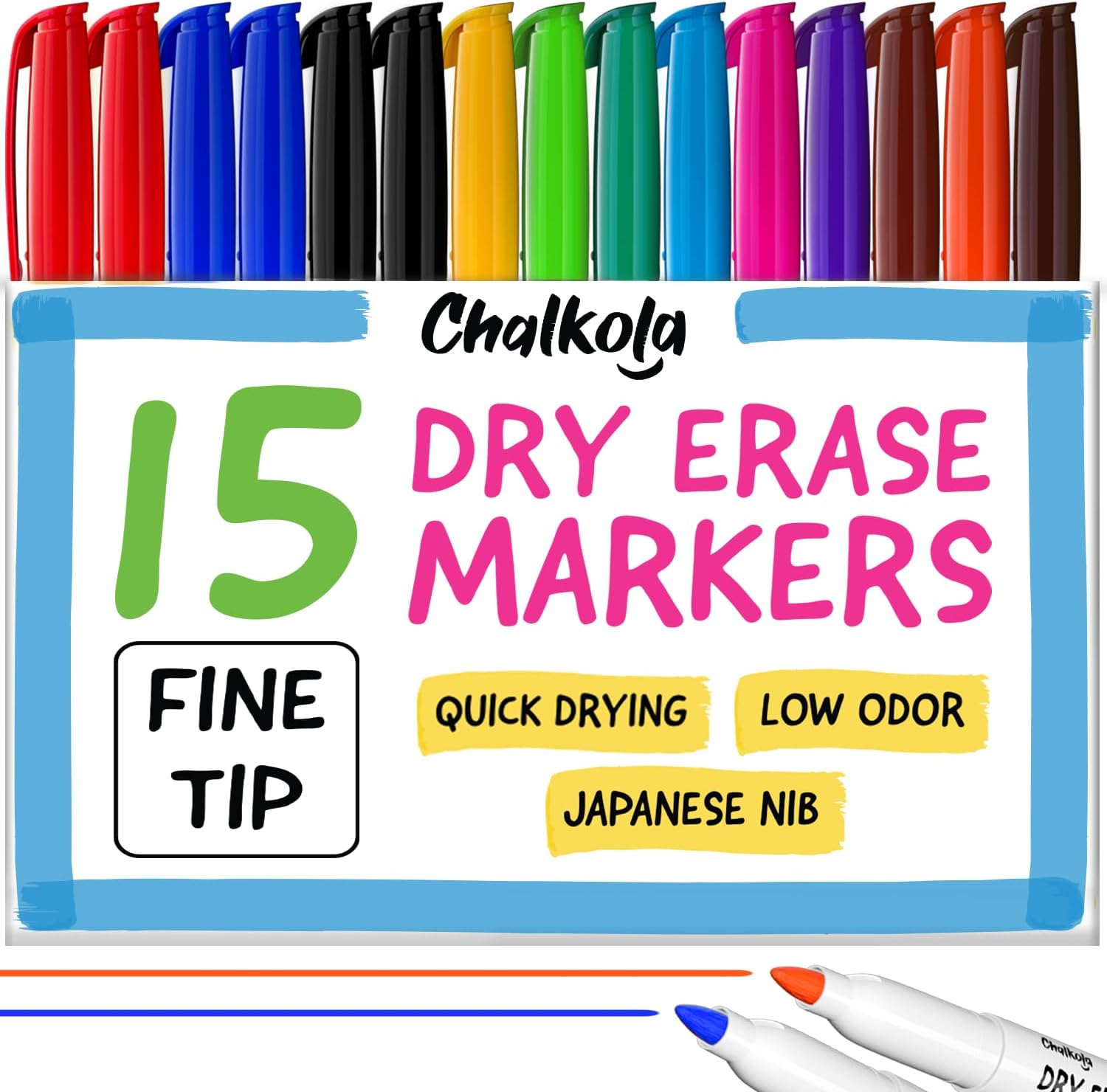
Chalkola's 15-pack fine tip markers are the entry size; the 60-pack fine tip is ideal for schools with homework-lamination programs.
Extra-fine tip: the niche but essential option
Extra-fine tip markers (0.7 mm stroke) are specialty tools for detailed work:
- Desktop dry-erase calendars with tiny date boxes
- Crossword puzzles on laminated sheets
- Map annotations in small areas
- Detailed diagrams for engineers, scientists, and designers
- Whiteboard art requiring sketched detail
Search volume on "extra fine tip dry erase markers" and "ultra fine tip dry erase markers" combined is 1,180/mo — smaller than chisel or fine tip but steady demand.
Best fine tip dry erase markers (for calendars, planners & detail)
Fine tip dry erase markers are the pick whenever you write small and up close — fridge and wall calendars, planners, charts, and detailed grids. A 1.5mm fine point handles most planning; drop to 0.7mm extra-fine only for very small squares. Chalkola’s fine-tip range is AP-certified, low-odor and erases clean:
| Use | Tip | Pick |
|---|---|---|
| Fridge / wall calendars, planners | Fine tip | 12-colour fine-tip pack |
| Detailed charts, small grids | Fine (extra-fine for tiny) | Fine-tip multipack |
| Value / whole-family desk pack | Fine tip | 15-pack fine tip |
| Board headings & teaching | Chisel | (see chisel picks above) |

Frequently asked questions
What tip size should I get for my whiteboard?
Chisel tip (5 mm) is the default for any whiteboard 3 feet or wider in a classroom or meeting room. Fine tip (1.5 mm) fits dry-erase planners, laminated charts, and personal desk whiteboards. Extra-fine (0.7 mm) is for tight grids like desktop calendars and crossword puzzles.
What's the difference between chisel tip and fine tip dry erase markers?
Chisel tip has an angled 5 mm wide flat nib that gives you two stroke widths (5 mm flat, 2 mm upright) in one marker. Fine tip has a 1.5 mm round point that writes the size of a ballpoint pen. Chisel is for classrooms and headlines; fine tip is for planners and detail writing.
Are fine tip dry erase markers better for planners?
Yes. Dry-erase planner grid boxes are sized for pen-width strokes, not 5 mm chisel marks. Fine tip keeps writing inside lines, fits more content per grid, and looks readable at desk distance. Chisel markers smudge across planner grid lines and make the planner unusable.
What does ultra-fine tip dry erase marker mean?
Ultra-fine tip (also called extra-fine) refers to dry erase markers with a 0.7 mm stroke width — even thinner than fine tip's 1.5 mm. They're used for desktop calendar grids, crosswords, map annotations, and detailed diagram work. Search volume is steady but lower than chisel or fine tip.
Can I use chisel tip markers on laminated paper?
Yes, but you may want fine tip instead. Laminated paper is fully compatible with chisel tip markers, but the 5 mm stroke often feels oversized for standard letter-size lamination. Fine tip fits more writing per sheet. Both tip sizes wipe off laminated surfaces cleanly.
What's the best dry erase marker for handwriting practice?
Fine tip (1.5 mm) is best for handwriting practice. It writes the size of a ballpoint pen, which is what students will use in their daily work — so practice on a laminated sheet with fine tip markers translates directly to pen handwriting. Chisel tip trains a different stroke.
What are the best fine tip dry erase markers?
The best fine tip dry erase markers write thin, consistent lines for calendars, planners, small charts and detailed handwriting, while staying low-odor and easy to erase. A 1.5mm fine point is the sweet spot for planning boards and fridge calendars; a 0.7mm extra-fine is for very small grids. Chalkola’s fine-tip dry erase markers come in 12 colours in a 60-pack and a value 15-pack, both AP-certified and low odor.
Is a fine tip or chisel tip dry erase marker better for me?
Choose fine tip for detailed, small writing — calendars, planners, charts, and anything read up close. Choose chisel tip for classrooms and whiteboards where you need bold, far-readable strokes and want thick-or-thin from one nib. Many people keep both: chisel for the board, fine tip for the calendar and detail work.